What happens to the bathtub?
82% of Houzz renovators who removed a tub enlarged the shower.
No votes yet. Yours will be the first. · saved on this device
Loading...
Bath Project Notes · Tub & Shower Conversions cost guide
A tub-to-shower conversion costs about $4,000 to $7,000 with a prefab base and surround, $7,000 to $11,000 with a tile-ready base, tiled walls and semi-frameless glass, and $11,000 to $15,000 or more for a curbless tiled shower in 2026. HomeAdvisor's average is about $3,000, mostly prefab stalls, within a $1,500 to $8,000 typical range; these ranges run higher because they include drain upsizing and a membrane. The drain, the subfloor under the old tub and the wall system decide where a project lands within those bands.
A conversion is priced like a walk-in shower with extra demolition and a drain problem attached. HomeAdvisor's average is $3,000 within a $1,500 to $8,000 typical range, with full conversions reaching $15,000, and the low end of that range describes a base and surround set over what the tub left behind. Once the drain is upsized to two inches, the valve raised to shower height and the walls opened to the studs, the realistic floor is closer to $4,000, and a tiled conversion with glass sits well above HomeAdvisor's upper figure. Houzz's feature findings show only 27% of bathroom renovators upgraded a bathtub, so most conversions start from a tub nobody wanted to replace.
The cost table and calculator on this page give the line items. This guide explains how those lines combine, which ones are hidden until the tub is out, how much of the bill is labor, how the schedule changes the price, what to cut first and what three realistic conversion budgets look like. Whether the tub should go at all is a separate question, covered in the tub versus shower comparison, and the assembly itself is described on the conversion service page.
| Item | Low | High | Unit | Notes |
|---|---|---|---|---|
| Prefab base and acrylic surround conversion | $4,000 | $7,000 | flat | Drain kept in place and upsized |
| Tiled conversion with tile-ready base and glass | $7,000 | $11,000 | flat | Membrane, centered or linear drain |
| Curbless tiled conversion | $11,000 | $15,000 | flat | Floor recessed, frameless glass |
| Tub removal and disposal | $300 | $900 | flat | HomeAdvisor lists removal alone at $150–$300; disposal and cast iron push it up |
| Drain upsizing and relocation, framed floor | $800 | $2,500 | flat | 2-inch line, new trap |
| Drain relocation on slab | $2,000 | $4,000 | flat | Saw-cut and re-pour |
| Subfloor repair | $15 | $35 | per sq ft | Unit price for hidden damage |
| Fixed glass panel, frameless | $800 | $2,000 | flat | No door; open entry |
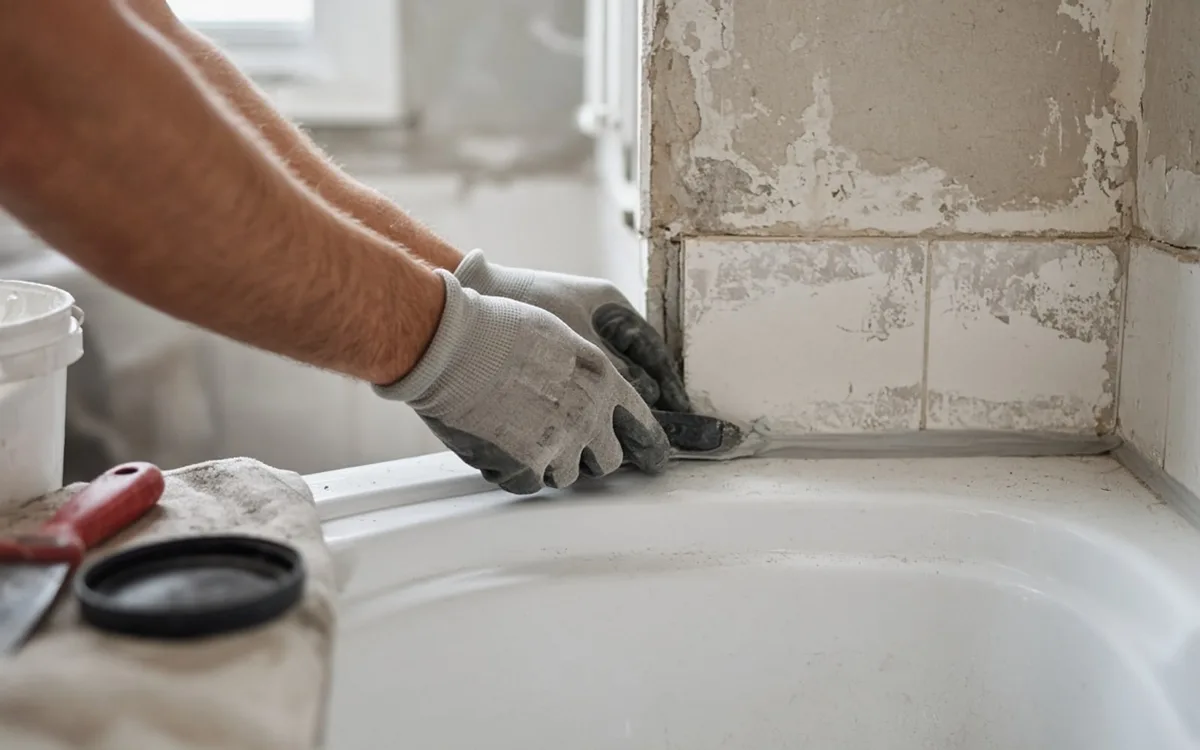
Three lines a shower rebuild usually does not carry. Tub removal and disposal runs $300 to $900 here, against HomeAdvisor's $150 to $300 for removal alone; the difference is disposal and cast iron, since a 300-pound cast-iron tub is broken up in place and hauled out in pieces. The drain changes from a 1.5-inch tub line at the alcove end to a 2-inch shower drain where the base needs it, which is $800 to $2,500 on a framed floor. The valve moves from tub height to shower height, a few hundred dollars of plumbing and wall work that is easy to forget in a quick estimate.
A fourth line is conditional: the subfloor at the drain end of the tub. Decades of a slow trap leak or overflow drips leave it soft more often than not, and the proposal should price it per square foot, typically $15 to $35, rather than as a surprise. Houzz found 37% of renovators went over budget in 2025, and in conversions the hidden subfloor is the usual reason. A written unit price turns that risk into a known, bounded number.
HomeAdvisor's 2026 line items, set beside this site's planning ranges in the table in this section, show where the two differ. Its shower door figure covers framed and semi-frameless doors, and its plumbing line covers a drain left close to where it was.
| Line item | HomeAdvisor, 2026 | This site's planning range |
|---|---|---|
| Shower stall (base and walls) | $1,000 – $8,000 | Inside the $4,000 – $15,000 path totals |
| Tub removal | $150 – $300 | $300 – $900 with disposal; cast iron at the top |
| Wall cleanup or repair | $300 – $800 | Inside the path totals |
| Shower door | $600 – $1,350 | $800 – $2,000 for a frameless fixed panel |
| Plumbing work | $300 – $2,400 | $800 – $2,500 to upsize and move the drain |
| Permits | $200 – $2,000 | Set by the city; see the permits guide |
The prefab path keeps the drain near the tub's position, sets a 60-by-30 or 60-by-32 end-drain base in a mortar bed, and installs a three-wall acrylic or solid-surface surround over a water-resistant substrate, with a pressure-balance valve and a framed door or a curtain. That totals $4,000 to $7,000 with demolition, plumbing, the fan and the permit. It is the path HomeAdvisor's walk-in average of about $5,400 describes, and it is out of service for the shortest time.
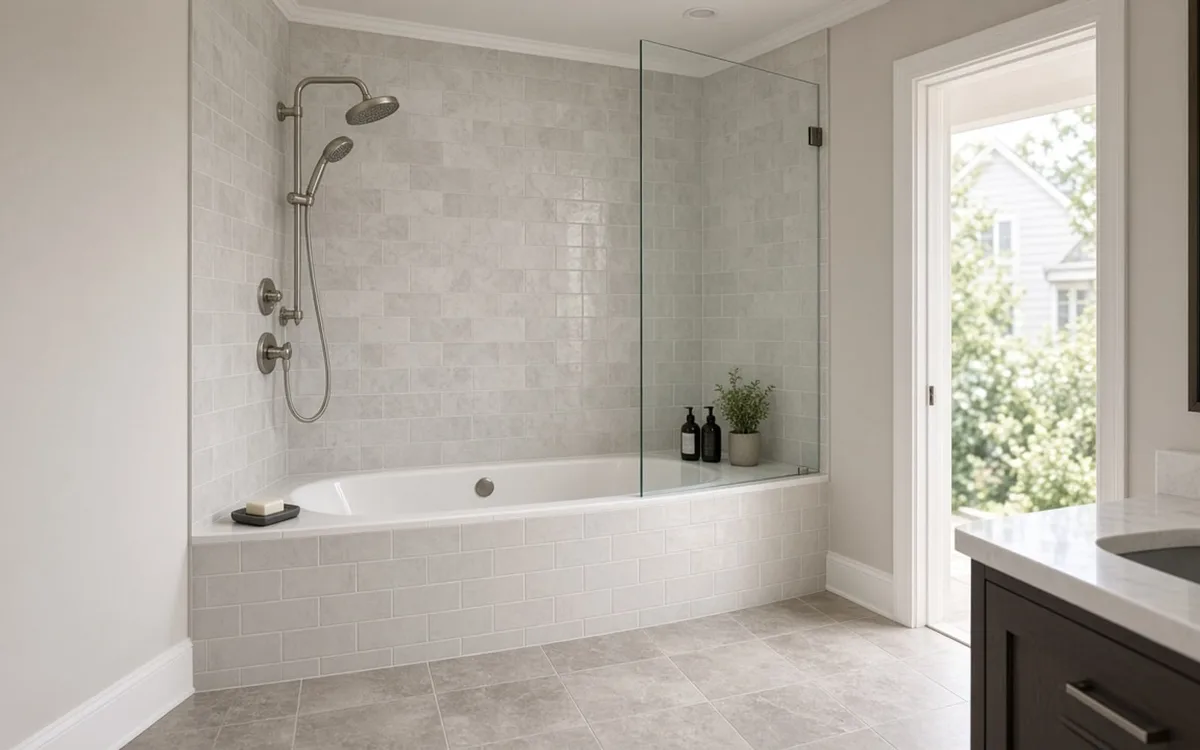
The tiled path moves the drain to the center or to a linear drain at the back wall, uses a tile-ready foam base or a mortar bed with a bonded membrane and a flood test, tiles the walls and adds semi-frameless glass, for $7,000 to $11,000. The curbless path recesses the floor so the shower floor sits below the bathroom floor, adds a linear drain, large-format tile and a frameless fixed panel, for $11,000 to $15,000 or more. The base comparison explains when each floor system is the sensible one.
HomeAdvisor puts labor at 40% to 65% of a bathroom remodel bill, with most contracting pros at $50 to $75 an hour and plumbers at $45 to $200, and a conversion sits toward the upper end of that share when it is tiled. Demolition, the drain work and the valve move are almost pure labor, and a tile setter's four to six days dominate the tiled path. The prefab path is closer to the lower end because the base and surround kit carry real material cost and go in quickly, often in a single long day after the plumbing is done.
That split explains why regional labor rates move tiled conversions more than prefab ones. In high-cost metros, where trade rates can run well above national figures, a tiled conversion can drift past $12,000 without any change in finishes, while a prefab conversion rises by a smaller margin. It also explains why two bids with similar totals can describe very different jobs: one may spend its labor on a new drain and a membrane, the other on a fast surround install over old drywall.
Moving a drain in a framed floor means opening the subfloor, rerouting the pipe between joists and patching. On a slab, it means saw-cutting the concrete, trenching to the new drain position, setting the trap, backfilling and re-pouring, which is $2,000 to $4,000 and one to two extra days. Slab foundations are common across the South and West, and that single line is why many slab-house conversions choose an end-drain prefab base or a linear drain placed near the existing drain rather than a centered drain.
A curbless conversion on a slab compounds the cost, because recessing the shower floor means removing concrete across the whole shower footprint, not just a trench. Expect the curbless path on a slab to start around $14,000 and run higher. A low curb avoids almost all of that and still gives a step of two inches or less; Houzz's data show 44% of renovators choosing a low curb, and the curbless versus curb comparison covers who genuinely needs zero threshold.
A prefab conversion typically runs three to five working days; a tiled one eight to twelve, plus a wait of one to three weeks for glass templated after tile. This Old House found 2 in 3 bathroom projects finish in one to four weeks, and conversions sit at the fast end unless a slab drain move or subfloor repair intervenes. Every added day is labor, and the flood test's 24-hour hold is a fixed wait that should appear on the schedule rather than be skipped.
The indirect cost matters more in a one-bathroom house. Our analysis of the EIA's 2024 household survey found 38.6% of occupied homes have exactly one full bathroom, and 36.6% of owner-occupied homes built before 1990 against 7.0% of newer ones, a 29.7 points gap; for those households the tub alcove is the only place to bathe. That is a legitimate reason to choose the prefab path even when tile is affordable, or to ask the pro to sequence the job so the toilet and sink stay usable every night and the shower is down for the fewest possible days.
Cut the glass before anything structural: a semi-frameless door or a fixed panel with an open entry instead of frameless saves $500 to $1,500. Cut the tile format next, since standard porcelain sets faster than large-format slabs. Keep the drain where the tub's was if a prefab end-drain base fits, which can save the entire relocation line. Drop the second niche, the bench and the second showerhead, each of which is a few hundred dollars and none of which changes how the shower handles water. HomeAdvisor prices a tub-to-shower conversion at $1,500 to $8,000; in a conversion, the finishes are where savings work.
Do not cut the drain upsizing, the membrane or waterproof substrate behind the walls, the mortar bed under a prefab base, the blocking for grab bars, or a ducted fan. Those are the lines a one-day overlay skips, and they are why an overlay can cost half as much. If the number is still too high after the first cuts, a well-installed prefab base with solid-surface walls is a durable shower; a tiled shower with a thin assembly is not. The calculator shows how each toggle moves the total.
Prefab hall-bath conversion on a framed floor, about $5,900: tub removal and disposal $450, drain upsized in place $900, valve raised with pressure-balance trim $700, subfloor repair of 8 square feet $200, solid-surface end-drain base in mortar $900, three-wall surround over waterproof board $1,500, framed door $600, fan and duct $450, permit $200. Tiled conversion with a centered drain and semi-frameless glass, about $9,800: add a foam base and bonded membrane, porcelain walls, a niche and a flood test, and drop the surround.
Curbless conversion on a slab with a linear drain, large-format tile, a fold-down seat, a thermostatic valve and a fixed frameless panel: $14,000 to $17,500, of which the slab work alone is $3,000 to $4,000. Each of these assumes the rest of the bathroom stays; if the vanity, toilet and floor change too, the project becomes a renovation and the renovation cost guide is the better benchmark.
By the numbers
Planning figures from published U.S. sources; every card links to where the number came from.
$1,500 to $8,000
for a tub-to-shower conversion; walk-in showers average about $5,400 (HomeAdvisor)
HomeAdvisor's shower remodel guide puts the average shower remodel at $7,000, a tub-to-shower conversion at $1,500 to $8,000 or more, and a walk-in shower at about $5,400. The low end is a prefabricated base and surround; the high end is a tiled, curbless custom shower.
HomeAdvisor / Shower Remodel Cost Guide (2025)37%
of renovators went over budget in 2025; credit card use rose to 34% (Houzz)
the 2026 Houzz & Home Study found nearly two in five homeowners exceeded their budget, usually by upgrading materials (35%) or expanding scope (31%), and credit card use rose five points to 34%. Bathrooms, where demolition often reveals water damage, are a common place for both.
Houzz / 2026 U.S. Houzz & Home Study (2026)40% to 65%
of a bathroom remodel bill is labor, per HomeAdvisor
Because plumbing, tile and electrical work are labor-intensive, HomeAdvisor estimates labor takes 40% to 65% of the total. That is why small bathrooms cost more per square foot and why a tile-heavy shower dominates a proposal.
HomeAdvisor / Bathroom Remodel Cost Guide (2025)2 in 3
bathroom remodels finish in one to four weeks; about one in five run past a month
This Old House's homeowner survey found most bathroom projects wrap within four weeks, but about one in five stretch longer than a month. Tile curing, glass lead times and inspections are the usual reasons, so plan for an alternate bathroom.
This Old House / Bathroom Remodel Cost (2026)The calculator uses the same bathroom remodeling benchmarks as this guide. Set the size and tier, then request a written estimate to check it against a real proposal.
Homeowner polls
82% of Houzz renovators who removed a tub enlarged the shower.
No votes yet. Yours will be the first. · saved on this device
Angi's typical range is $6,648 to $17,646; Houzz's major-remodel median is $22,000.
No votes yet. Yours will be the first. · saved on this device
No votes yet. Yours will be the first. · saved on this device
Because they describe different jobs. The lowest quotes set a base and surround over what the tub left, keep the tub drain and skip the substrate inspection. The middle quotes upsize the drain, raise the valve and install a proper waterproof wall system. The highest quotes tile over a membrane with glass or go curbless. Ask each bidder to list drain size, wall substrate and base setting method before comparing totals.
Usually $200 to $500 over a steel or acrylic tub, because it is broken up with a sledge in place, carried out in pieces and hauled by weight. It also takes longer and makes more noise and dust, so the proposal should include floor protection and dust control. Some pros credit a small amount for scrap metal; most simply include disposal in the removal line.
A straight tub replacement with a new surround is often $3,000 to $6,000, similar to a prefab conversion, because the drain stays and the demolition is the same. The cost difference is small; the decision is about how the household bathes and whether another tub remains in the house. A conversion with glass or tile moves above a tub replacement quickly.
Commonly $15 to $35 per square foot of subfloor replaced, and most tub-end damage covers 6 to 20 square feet, so $150 to $700. If the damage reaches the joists, sistering adds a few hundred dollars per joist. The number becomes much larger only when the leak has run for years into a ceiling below, which the pro should check from underneath before quoting.
Moving or upsizing a drain, moving the valve or adding a fan circuit usually triggers a plumbing or building permit. HomeAdvisor puts a bathroom permit at $200 to $2,000 depending on the project, with plan review and value-based fees at the top. A like-for-like surround swap may not. The permits article explains the triggers and the inspection sequence; the proposal should state who pulls the permit and whether the fee is included.
Rarely by much. A tub valve sits about 28 inches off the floor, so a shower valve moves it to 38 to 48 inches anyway, and an old valve may lack the scald protection current codes expect. Replacing the valve body during rough-in costs $150 to $400 in parts; reusing it and then replacing it later means reopening a finished wall.
About $3,000 to $5,000 in most markets, for the membrane system, the tile and the tile setter's four to six days, plus the difference between a framed door and semi-frameless glass. The gap widens with large-format tile and narrows when a tile-ready foam base replaces a mortar bed. The calculator's tier setting models that difference for your bathroom size.
 Complete Bathroom Renovation · Cost guideComplete bathroom renovation cost in 2026: tiers, add-ons and what to cut first
A complete bathroom renovation in 2026 typically costs $9,000 to $16,000 with a prefab shower, $14,000 to $28,000 with a tiled shower and glass, and $22,000 to $50,000 or more when a drain or wall moves.
 Walk-In Shower Installation · Cost guideWalk-in shower installation cost in 2026: what each layer of the assembly adds
A walk-in shower installed in an existing footprint costs about $3,500 to $7,000 with a prefab base and acrylic surround, $7,000 to $13,000 tiled on a tile-ready base with semi-frameless glass, and $11,000 to $18,000 curbless with a linear drain and frameless glass in 2026.
 Accessible Bathroom Remodeling · Cost guideAccessible bathroom remodel cost in 2026: what each level of change adds
An accessible bathroom remodel costs about $1,500 to $5,000 for basics added to an existing room, $10,000 to $18,000 to turn a tub into a curbless roll-in shower with a seat, and $20,000 to $35,000 or more for a full renovation that widens the door and moves the toilet in 2026.
 Service guideTub & Shower Conversions
A tub-to-shower conversion removes the bathtub and builds a shower in its alcove, usually with a new drain, a rebuilt substrate, a waterproofing membrane, new walls and an enclosure.
Service guideWalk-In Shower InstallationA walk-in shower installation rebuilds the bathing area from the subfloor up: a sloped base, a drain bonded to a waterproofing membrane, wall board and membrane, a valve, tile or panels, and an enclosure with a defined entry.
Service guideAccessible Bathroom RemodelingAccessible bathroom remodeling plans the room around a specific person's transfers, reach, mobility aid and likely future needs: turning space, a curbless shower, blocking and grab bars, a comfort-height toilet, a reachable vanity, nonslip surfaces and a wider door.
 Free toolBathroom remodel cost calculator
Size, material tier and complexity in, a realistic budget range out.
 Free toolBathroom comparisons: the five decisions that change the assembly
Side-by-side tables for the decisions that change the price most.
 Free toolBathroom remodel quiz: find your scope and check the numbers
10 questions that show what you already know and what to check next.
 Free toolBathroom remodel polls: see what other homeowners are choosing
See what other planners chose and add your vote.
Tell us the size, the condition of what is there now, and what you want to change. Bath Project Notes passes your request to independent local professionals, who reply with written, no-obligation estimates. The service is free to use.