What total budget are you planning for?
Angi's typical range is $6,648 to $17,646; Houzz's major-remodel median is $22,000.
No votes yet. Yours will be the first. · saved on this device
Loading...
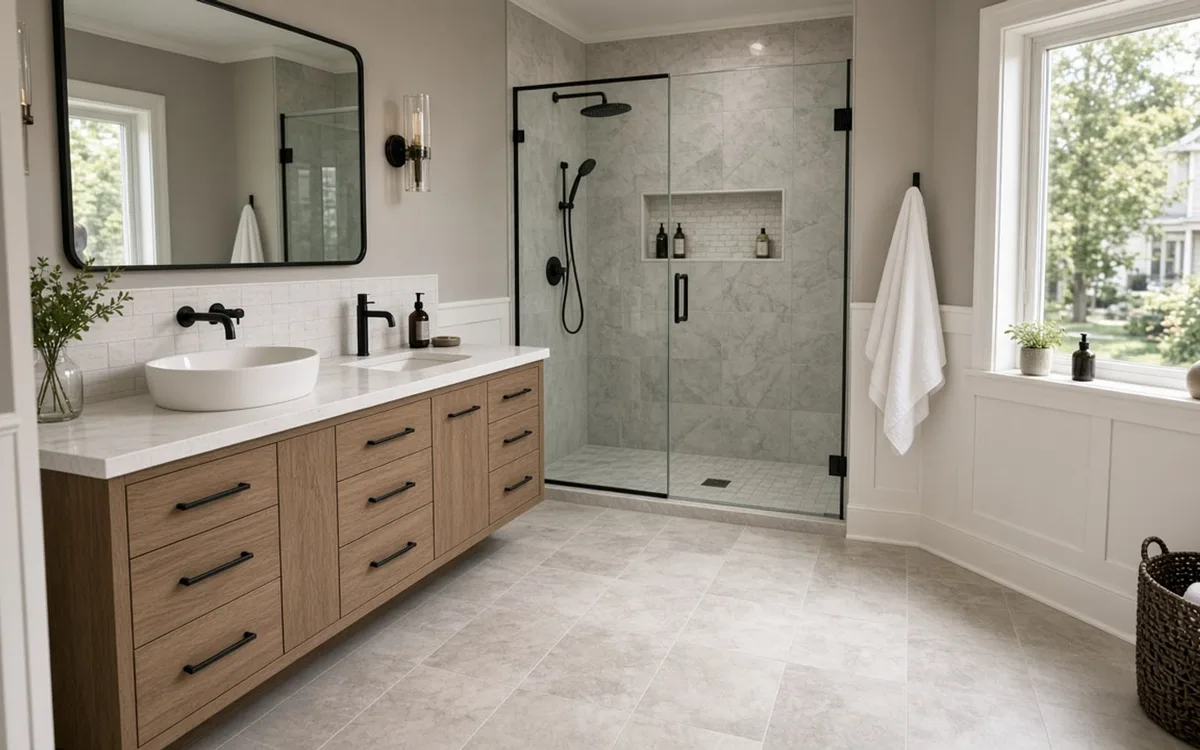
Bath Project Notes · Complete Bathroom Renovation cost guide
A complete bathroom renovation in 2026 typically costs $9,000 to $16,000 with a prefab shower, $14,000 to $28,000 with a tiled shower and glass, and $22,000 to $50,000 or more when a drain or wall moves. Published averages sit between $12,000 and $16,000, with labor taking roughly half. This guide explains the tiers, the add-ons, the schedule's effect on price and the order in which to cut when a proposal comes in high.
Published benchmarks frame the range. HomeAdvisor's average is $12,151, This Old House's 2026 average is $15,586, Angi's benchmark is $6,648 to $17,646, and Houzz's medians are $13,000 across all bathroom remodels and $22,000 for a major one. HomeGuide's $100 to $500 per square foot is the widest, because it spans a refreshed hall bath and a relocated primary bath. The cost table and calculator on this page turn those anchors into a range for your room.
This guide is about the money only. What a renovation involves behind the tile, how it is sequenced and how to compare proposals are on the service page; the 2026 cost guide covers every scope. Here the questions are narrower: what each tier buys, what the add-ons cost, how labor and materials split, what the schedule does to the price, what to cut first, and what three realistic budgets look like.
| Item | Low | High | Unit | Notes |
|---|---|---|---|---|
| Same-layout renovation, prefab shower base and surround | $9,000 | $16,000 | flat | 40–60 sq ft bath, stock vanity |
| Same-layout renovation, tiled shower and glass | $14,000 | $28,000 | flat | Frameless glass, quartz top, ducted fan |
| Renovation with drain or wall relocation | $22,000 | $50,000 | flat | Rough-in inspection, framing, possible slab cutting |
| Renovation cost per square foot | $100 | $500 | per sq ft | HomeGuide range; wet area share drives it |
| Drain relocation, wood-framed floor | $1,500 | $4,000 | flat | Access from below or open floor |
| Drain relocation, slab foundation | $3,000 | $6,000 | flat | Saw-cut and re-pour |
| Electric radiant floor heat, installed | $800 | $2,000 | flat | Dedicated circuit and thermostat |
The economy tier is a prefab shower base with an acrylic or solid-surface surround, a framed or semi-frameless door, a stock vanity with a cultured marble or laminate top, a standard toilet, porcelain floor tile in a stock format, a surface-mounted light and a ducted fan. In a same-layout 40-to-50-square-foot bathroom it lands at $9,000 to $16,000, and the calculator's 0.6 multiplier on a $300-per-square-foot base reflects it. It is the right tier for a hall bath, a rental or a house that will sell soon.
The standard tier replaces the shower with a tiled one on a bonded membrane with a flood test, semi-frameless glass, a semi-custom vanity with a quartz top, a comfort-height toilet, better lighting and a humidity-sensing fan; $14,000 to $28,000 in the same room. The premium tier adds a curbless entry with a linear drain, large-format tile, frameless glass, a custom vanity, a thermostatic valve and usually a heated floor, at 1.6 times the standard rate, and it is where Houzz's $30,000 median for a major remodel of a primary bath over 100 square feet sits; its $15,000 median across all primary baths falls in the standard tier.
This Old House's 2026 pricing is an outside check on those tiers. For a 50-square-foot bath it lists $8,478 to $10,883 basic, $14,609 to $19,040 midrange and $27,492 to $35,808 high-end, and its size ranges run from $12,695 for a small bath to $24,715 for a primary one. The table in this section sets both beside the tier ranges used here.
| Tier or size | This Old House, 2026 | This site's planning range |
|---|---|---|
| Economy or basic, 50 sq ft | $8,478 – $10,883 | $9,000 – $16,000 |
| Standard or midrange, 50 sq ft | $14,609 – $19,040 | $14,000 – $28,000 |
| Premium or high-end, 50 sq ft | $27,492 – $35,808 | About $22,000 – $45,000 (1.6 × standard) |
| Small bath, 40–60 sq ft | $12,695 – $14,845 | Economy to standard |
| Medium bath, 70–90 sq ft | $15,920 – $18,070 | Standard |
| Large bath, 100–120 sq ft | $19,166 – $21,295 | Standard to premium |
| Primary bath, 130+ sq ft | $22,370 – $24,715 | Standard to premium |
The large add-ons are structural. A drain relocation on a framed floor runs $1,500 to $4,000 and on a slab $3,000 to $6,000, and either triggers a rough plumbing inspection; a wall or door change adds framing, a header and drywall, which the calculator prices at a 1.5 multiplier on the whole job because it touches everything. A curbless entry with a linear drain adds about $2,800; frameless glass about $2,500; a double vanity with its second drain and supply about $2,200; a heated floor about $1,400; a comfort-height toilet with a bidet outlet about $900; a ducted humidity-sensing fan about $600.
The small add-ons are the ones nobody prices until the end: a recessed niche, a shower bench, a second showerhead or a handheld on a slide bar, a medicine cabinet, a pocket door, upgraded tile trim, a linen tower, blocking for future grab bars. Individually they are $150 to $800; together they are often $2,000 to $4,000, which is the amount by which many renovations exceed their proposals. Ask for them as a list with prices at the proposal stage, and decide each one before demolition. The calculator carries the six largest as toggles.
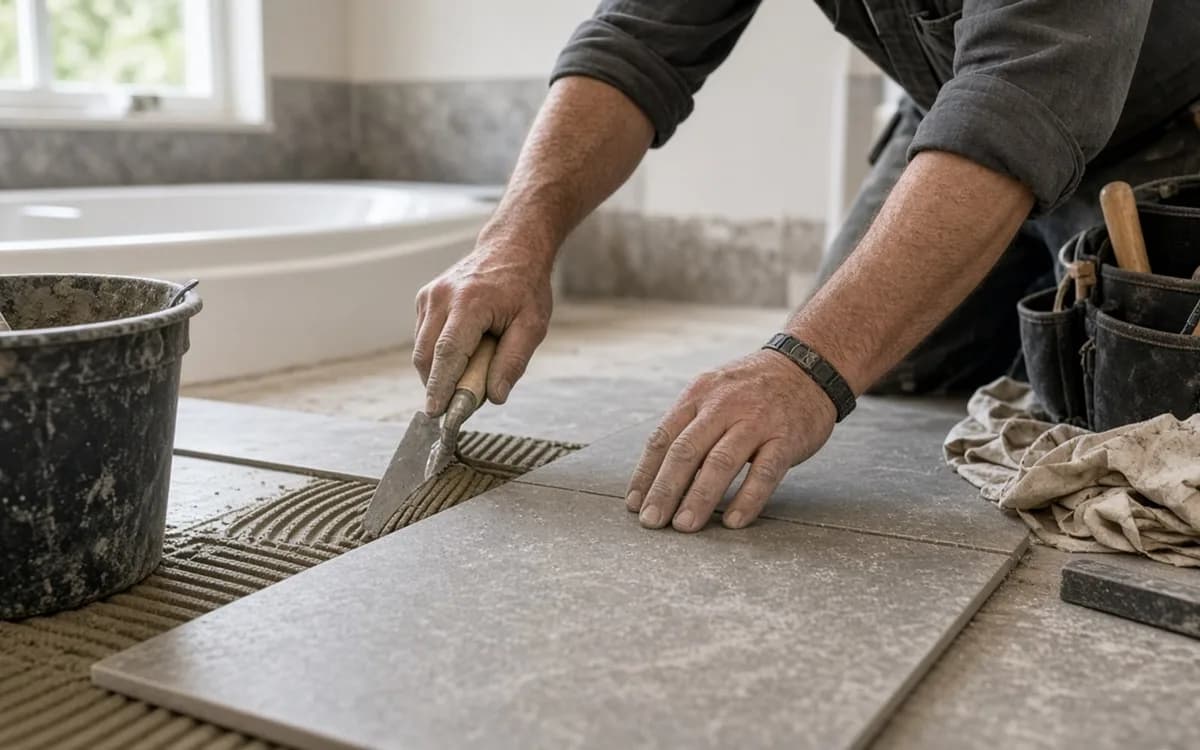
HomeAdvisor's estimate that labor is 40% to 65% of the bill applies squarely here, and a full renovation sits toward the upper end because every trade is involved: demolition, plumbing rough and trim, electrical rough and trim, framing and blocking, backer and membrane, tile, glass, painting, finish carpentry and often a fan and duct specialist. HomeAdvisor lists most contracting pros at $50 to $75 an hour and plumbers at $45 to $200 an hour. In a $22,000 standard-tier renovation, labor is typically $11,000 to $14,000, assembly materials $2,500 to $4,000, and finishes $5,000 to $8,000.
The split changes with tier in a predictable way. Moving from economy to standard adds mostly labor, because tile setting replaces panel installation and a flood-tested membrane replaces a drop-in base. Moving from standard to premium adds mostly materials, because large-format porcelain, a custom vanity and frameless glass cost more to buy but not proportionally more to install. That is why a premium bid from a good contractor and a standard bid from a poor one can be close in labor and far apart in what you get.
This Old House reports that 2 in 3 bathroom remodels finish in one to four weeks. A same-layout standard-tier renovation typically takes two to three weeks of site work plus glass lead time; a drain move adds a week and an inspection; a wall change adds another. Each added week is more labor days, but the larger schedule cost is idle time: a crew waiting for a vanity, an inspection or a glass template is either billing standby or, more often, leaving for another job and returning late.
Two things shrink the schedule's cost. First, having every rough-in item on site and every lead-time item dated before demolition, which is the point of the planning guide. Second, deciding in advance how discovered damage is priced, so a wet subfloor is a two-day repair at a known rate rather than a week of negotiation with the room open. Houzz's finding that 37% of renovators went over budget in 2025 is, in bathrooms, largely a story about those two things.
Cut in this order. First, the premium finishes that add cost without changing the assembly: frameless to semi-frameless glass saves about $1,000; custom to semi-custom vanity saves $1,000 to $3,000; large-format to standard porcelain saves $500 to $2,000 in material and labor; thermostatic to pressure-balance valve saves $300 to $900. Second, the add-ons that can be done later without opening anything: the bidet seat, the medicine cabinet, the linen tower, the second showerhead. Third, the layout: if a drain move is on the list and the reason is preference rather than function, keeping every drain in place saves $1,500 to $6,000 plus a week.
Do not cut the membrane, the flood test, the fan and duct, the blocking for grab bars, the dedicated circuit for a heated floor if there is any chance of wanting one, or the subfloor repair. Those are the items that cost multiples to add later. If the proposal is still too high after the first three cuts, the honest answer is a tiered scope: a shower rebuild now with the finishes refreshed later, rather than a thinner renovation of everything. A CDC analysis counted 234,094 nonfatal bathroom injuries treated in emergency departments in 2008, which is why the grab-bar blocking stays.
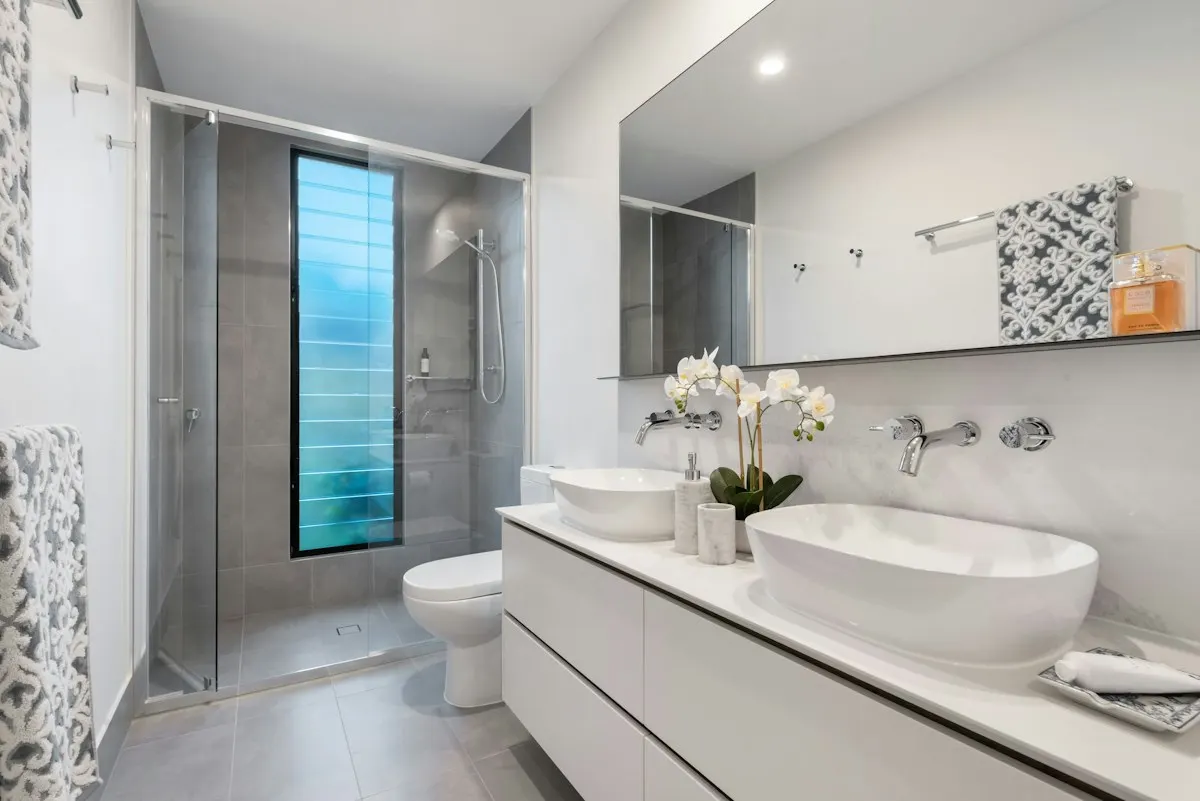
Economy hall bath, 40 square feet, same layout, about $11,500: demolition and disposal $900, plumbing rough and trim $1,600, electrical and fan $1,100, prefab base and solid-surface surround $2,600, semi-frameless door $900, stock vanity, top and faucet $1,200, toilet $400, floor tile and labor $1,300, paint, trim and accessories $700, permit $300, contingency $500. Labor is about $6,000 of that. It runs above Houzz's $7,000 guest-bath median because it replaces the shower, which many guest-bath jobs leave alone. Houzz's feature findings show 73% of bathroom renovators upgraded sinks and 76% countertops, which is why the vanity line appears in every budget.
Standard primary bath, 60 square feet, same layout, about $24,000: demolition $1,100, plumbing $2,400, electrical, lighting and fan $1,800, tiled shower on a bonded membrane with flood test and tile-ready base $6,800, semi-frameless glass $1,500, semi-custom vanity with quartz top and faucet $3,600, comfort-height toilet $600, porcelain floor with heated mat $2,600, paint, trim and accessories $1,000, permit $500, contingency $2,100. Premium primary bath, 90 square feet, drain moved for a double vanity and a curbless shower with a linear drain, frameless glass, custom vanity and large-format tile: $42,000 to $55,000, which is the range the calculator returns for that input.
A full renovation replaces every water-using fixture, which is the moment to capture operating savings the EPA has measured. Bathrooms account for 50%+ of a home's indoor water use. Replacing an old 6-gallon toilet with a WaterSense 1.28-gallon model saves about 13,000 gal a year; a 2.0-gpm showerhead saves 2,700 gal and 330 kWh of water heating; a 1.5-gpm faucet saves 700 gal. WaterSense fixtures cost little or nothing more than their standard equivalents.
The other running cost is maintenance. A tiled shower with sealed cement grout needs an hour and a bottle of sealer every year or two; epoxy grout at a few hundred dollars more removes that. A humidity-sensing fan runs itself and prevents the mold that a manual fan, switched off too soon, allows. A heated floor adds a modest electricity cost in winter and is usually run on a schedule. None of these change the decision, but they belong in a ten-year view of the budget.
By the numbers
Planning figures from published U.S. sources; every card links to where the number came from.
$12,151
average bathroom remodel per HomeAdvisor, with a $6,651 to $17,657 typical range
From more than 10,000 surveyed customers, HomeAdvisor puts a half bath at $1,500 to $15,000, a full bath at $3,500 to $20,000 and a primary bathroom at $7,000 to $30,000. Fixture relocation and concealed damage push a specific bath outside those brackets.
HomeAdvisor / Bathroom Remodel Cost Guide (2025)$15,586
average bathroom remodel per This Old House, with a $6,456 to $24,715 range (2026)
This Old House's 2026 pricing shows a small 40-to-60-square-foot bath at $12,695 to $14,845 and a 130-plus-square-foot primary bath at $22,370 to $24,715; shower installation alone averages $8,044.
This Old House / Bathroom Remodel Cost (2026)$6,648 to $17,646
typical bathroom remodel range reported by Angi (U.S. planning reference)
Angi's bathroom remodel cost guide reports a $6,648 to $17,646 project range.
Angi / How Much Does a Bathroom Remodel Cost (2026)$22,000
median spend on a major bathroom remodel among Houzz renovators (2024 projects)
Major bathroom remodels in Houzz's 2025 study carried a $22,000 median, rising to $25,000 for rooms of 100 square feet or more. A major remodel typically replaces the shower or tub, vanity, floor and wall finishes together.
Houzz / 2025 U.S. Houzz Bathroom Trends Study (2025)The calculator uses the same bathroom remodeling benchmarks as this guide. Set the size and tier, then request a written estimate to check it against a real proposal.
Homeowner polls
Angi's typical range is $6,648 to $17,646; Houzz's major-remodel median is $22,000.
No votes yet. Yours will be the first. · saved on this device
Houzz found 75% of bathroom renovators upgraded the shower and 27% the tub.
No votes yet. Yours will be the first. · saved on this device
55% of Houzz renovators chose custom or semi-custom vanities; 61% of NKBA clients want dual sinks.
No votes yet. Yours will be the first. · saved on this device
Because the fixed costs dominate. A shower assembly, a toilet, a vanity, a fan and permits cost about the same in a 40-square-foot room as in an 80-square-foot one, so the small room's per-square-foot figure is high and the large room's is low, before any tier or layout change. HomeGuide's $100 to $500 range captures that. Use per-square-foot figures to check a total, not to build one.
Ten to fifteen percent for a house built after 1990 with no leak history, and fifteen to twenty percent for older houses, slab foundations with a planned drain move, or any known leak. In dollar terms that is $1,500 to $5,000 on a standard-tier renovation. Keep it as a separate line that is only spent on documented conditions at pre-agreed unit rates, not on upgrades.
Yes. Keeping every drain, the door and the walls where they are removes the rough plumbing move, the slab cut or joist work, a rough inspection, and a week of schedule, which together are $2,000 to $8,000 depending on the floor. If the layout is merely inconvenient rather than unworkable, that saving usually funds the entire step from standard to premium finishes.
NKBA reports 61% of designers say clients want dual vanities, and in a primary bath used by two adults at the same time in the morning it is the most-used upgrade in the room. The add-on is about $2,200 for the second sink, faucet, drain and supply plus the wider cabinet and top, more if a drain has to be moved to reach the second position. In a hall bath or a room under 60 inches wide, a single wide sink usually serves better.
HomeAdvisor puts a bathroom remodel permit at $100 to $1,000, with the top of that range in cities that charge by project value or require separate trade permits and plan review. Some jurisdictions add a fee for each re-inspection. The proposal should state whether permit fees are included or billed at cost, and who pulls them; the permits guide on the blog covers the process.
Sometimes a few hundred dollars, with three cautions. Demolition around a tub often reveals plumbing that must be capped by a plumber before the room is safe; old tile and backer are heavy and disposal costs are real; and contractors price their demolition partly as a survey of the conditions they will build on, so an owner-demolished room may get a less confident bid. If you do it, stop at the fixtures and finishes and leave plumbing and wiring alone.
Houzz's 2026 study puts a major remodel of a primary bath over 100 square feet at a $30,000 median in 2025, against $18,000 for smaller primary baths. The extra money goes to more tile, more floor, usually a separate tub and shower, a double vanity and more lighting, but the shower assembly and the fixed costs do not double, so the per-square-foot figure falls. Large bathrooms are also more often the ones with layout changes, which is where the upper end of the range comes from.
 Walk-In Shower Installation · Cost guideWalk-in shower installation cost in 2026: what each layer of the assembly adds
A walk-in shower installed in an existing footprint costs about $3,500 to $7,000 with a prefab base and acrylic surround, $7,000 to $13,000 tiled on a tile-ready base with semi-frameless glass, and $11,000 to $18,000 curbless with a linear drain and frameless glass in 2026.
 Tub & Shower Conversions · Cost guideTub-to-shower conversion cost in 2026: from tub removal to finished glass
A tub-to-shower conversion costs about $4,000 to $7,000 with a prefab base and surround, $7,000 to $11,000 with a tile-ready base, tiled walls and semi-frameless glass, and $11,000 to $15,000 or more for a curbless tiled shower in 2026.
 Accessible Bathroom Remodeling · Cost guideAccessible bathroom remodel cost in 2026: what each level of change adds
An accessible bathroom remodel costs about $1,500 to $5,000 for basics added to an existing room, $10,000 to $18,000 to turn a tub into a curbless roll-in shower with a seat, and $20,000 to $35,000 or more for a full renovation that widens the door and moves the toilet in 2026.
 Service guideComplete Bathroom Renovation
A complete bathroom renovation rebuilds the bathing area, vanity, toilet, floor, wall finishes, lighting and ventilation together, and may move drains, walls or the door.
Service guideWalk-In Shower InstallationA walk-in shower installation rebuilds the bathing area from the subfloor up: a sloped base, a drain bonded to a waterproofing membrane, wall board and membrane, a valve, tile or panels, and an enclosure with a defined entry.
Service guideTub & Shower ConversionsA tub-to-shower conversion removes the bathtub and builds a shower in its alcove, usually with a new drain, a rebuilt substrate, a waterproofing membrane, new walls and an enclosure.
 Free toolBathroom remodel cost calculator
Size, material tier and complexity in, a realistic budget range out.
 Free toolBathroom comparisons: the five decisions that change the assembly
Side-by-side tables for the decisions that change the price most.
 Free toolBathroom remodel quiz: find your scope and check the numbers
10 questions that show what you already know and what to check next.
 Free toolBathroom remodel polls: see what other homeowners are choosing
See what other planners chose and add your vote.
Tell us the size, the condition of what is there now, and what you want to change. Bath Project Notes passes your request to independent local professionals, who reply with written, no-obligation estimates. The service is free to use.