Northeast
Highest share of one-bathroom homes (56.1%) in EIA's 2024 data, with cast-iron drains, plaster and notched joists common. Plan the outage day by day, hold a 15–20% reserve, and expect labor above the national average.
Loading...
Bath Project Notes · Locations
National averages hide regional differences that matter more in bathrooms than in most rooms: how many homes have only one bathroom, whether the floor is a slab, how humid the air is, how hard the water runs, and what labor and permits cost. This hub summarizes those differences across the Northeast, South, Midwest and West so you can adjust the benchmarks before requesting estimates.
Photo: kevin Baquerizo · License.
HomeAdvisor's $12,151 average is built from more than 10,000 projects across every market. A same-scope bathroom in a 1920s Boston triple-decker and a 2008 Phoenix subdivision will not land on the same number, because one has cast-iron drains, plaster and a single bathroom, and the other has a slab under the tub and a second bath down the hall. Labor rates differ by half or more between metros on top of that.
Use them to reset expectations before you run the calculator and before you send a brief through the contact page to pros who work in your area.
Highest share of one-bathroom homes (56.1%) in EIA's 2024 data, with cast-iron drains, plaster and notched joists common. Plan the outage day by day, hold a 15–20% reserve, and expect labor above the national average.
Most homes have two full baths (53.0%), so outages are tolerable, but slab foundations make drain moves expensive and humidity demands a strong, humidity-sensing fan and a membrane beyond the shower.
Basements under most bathrooms simplify drain relocation and inspection access. Insulate the exhaust duct through cold attics, and budget for hard-water protection on glass and valves in many areas.
Slabs and hard water are common, labor in coastal metros is the highest in the country, and seismic codes require anchoring tall storage. Some cities restrict new gas lines, which affects water-heater choices for multi-head showers.
Labor is 40% to 65% of a bathroom bill by HomeAdvisor's estimate, and tile setters and plumbers in the Northeast and West Coast metros charge well above the interior South and Midwest. Permit and inspection requirements vary by city; some require licensed plumbers for any drain work and a rough-in inspection before the membrane is covered, others allow a general contractor's crew. Tile and fixtures ship nationally, so material cost varies less than labor.
Housing age sets what is found under the tub. Older regions carry cast-iron drains that cannot bond to a modern membrane, galvanized supply lines, plaster walls and joists notched by past plumbers. Newer Sun Belt housing is more likely to sit on a slab, which makes moving a drain expensive but keeps walls simple. Ask local pros what they routinely find in your neighborhood's era of construction. Era also predicts the bathroom count: our analysis of the EIA's 2024 survey found 36.6% of owner-occupied homes built before 1990 have one full bathroom against 7.0% of newer homes, a 29.7 points gap.
EIA's 2024 Residential Energy Consumption Survey shows 56.1% of occupied Northeast homes have exactly one full bathroom, against 30.3% in the South, where 53.0% have two. Nationally, by our analysis, 38.6% of homes have one full bath, 46.8% two and 11.8% three. These are room counts, not remodel rates, but they explain why Northeast proposals so often include nightly toilet resets and temporary curtains, and why Southern households can tolerate a three-week outage.
In a one-bath house, ask for a sequence that keeps the toilet usable except during rough-in and floor work, and that finishes the shower behind a curtain while glass is on order. This Old House found 2 in 3 bathroom projects finish within four weeks; in a one-bath house the goal is to make the unusable days as few as possible inside that window. A half bath softens the outage: our analysis puts homes with at least one at 30.3% nationally, 33.6% in the Northeast and Midwest against 26.4% in the West.
| Region | One full bath (2024 stock) | Two full baths | Half bath | Planning note |
|---|---|---|---|---|
| Northeast | 56.1% | 35.3% | 33.6% | Cast-iron drains, plaster; plan the one-bath outage carefully |
| Midwest | 45.0% | 41.5% | 33.6% | Basements ease drain moves; insulate exhaust ducts |
| South | 30.3% | 53.0% | 29.3% | Slab foundations; humidity demands stronger ventilation |
| West | 33.3% | 49.9% | 26.4% | Slabs common; hard water; seismic anchoring for tall cabinets |
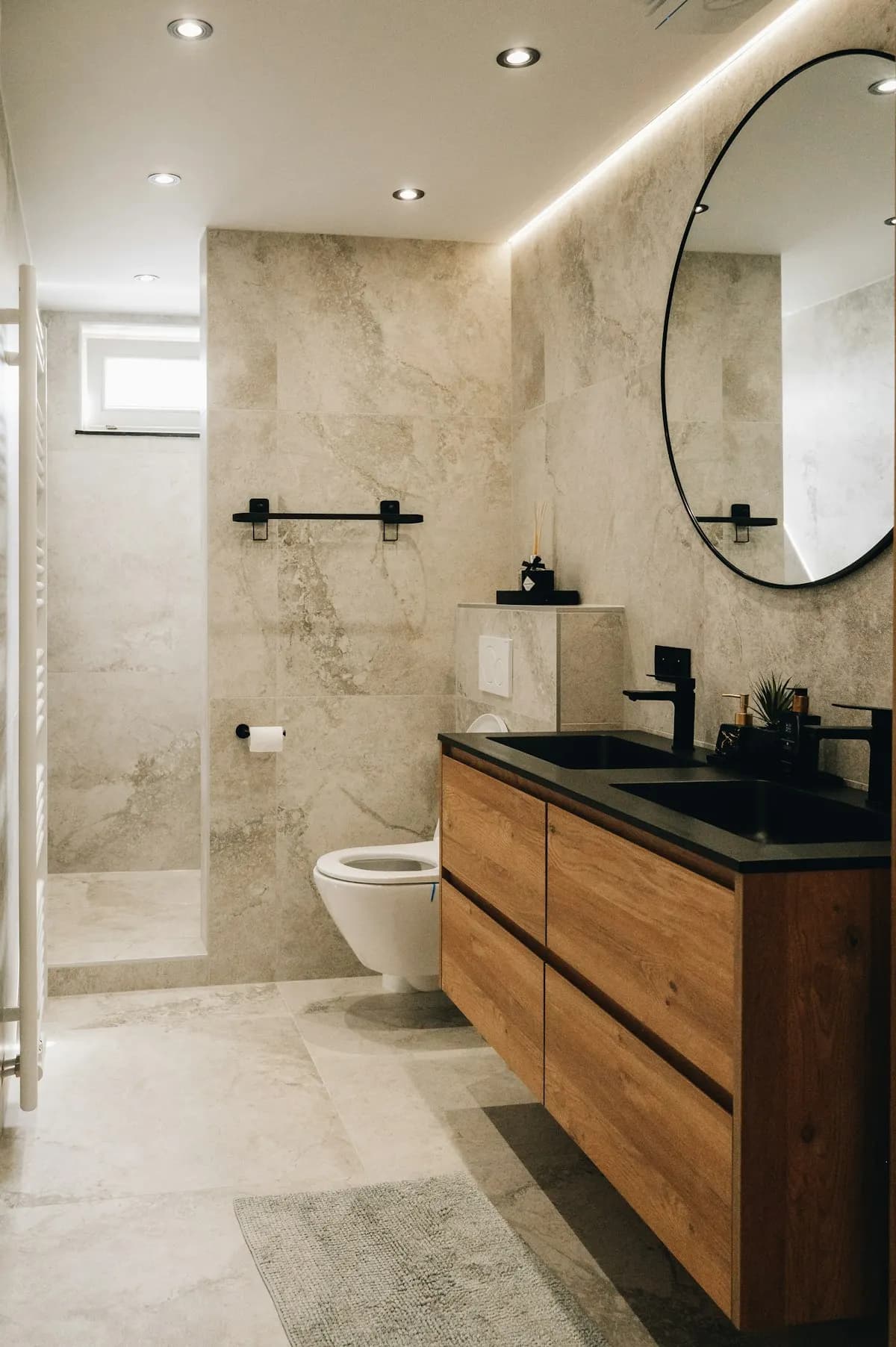
Humid regions need more fan capacity and a humidity-sensing control, plus a membrane on the floor outside the shower, because moisture lingers. Cold regions need the exhaust duct insulated through the attic so condensation does not drip back into the fan, and a shower niche on an exterior wall needs insulation behind it. Hard-water regions (much of the Southwest, Plains and Florida) etch glass and clog valves; a protective coating on the glass and a valve with a serviceable cartridge are worth the small upcharge.
Slab foundations across the South and West make relocating a drain a concrete-cutting job at $2,000 to $6,000, which argues for keeping the shower and toilet where they are or choosing a base whose drain lands on the existing line. Coastal air corrodes plated finishes; specify solid brass fixture bodies. The walk-in shower page and renovation page carry the assembly details.
Start from the scope range on the services hub, then shift by the labor factor pros in your area quote. As a planning rule, coastal Northeast and West Coast metros run 15 to 35 percent above the national figures for the same scope, the interior South and Midwest 10 to 20 percent below, and rural or mountain markets vary with trade availability. Older housing adds a hidden-condition reserve of 15 to 20 percent rather than 10, because the tub-out surprise is more likely.
Resale expectations move with the market too. The Cost vs. Value report publishes regional and metro figures, and the midrange bath's roughly 80% national recoup is higher in some Western markets and lower in parts of the Midwest. Check the regional table before letting resale drive the scope, and remember that the assembly behind the tile recovers more than the tile.
Homes with only one full bathroom: 38.6% nationally. Highest in Rhode Island (61.5%), New York (60.4%), District of Columbia (58.8%); lowest in Arizona (20.6%), Nevada (22%), Florida (22%).
Homes occupied by their owner: 67.6% nationally. Highest in Delaware (80.7%), West Virginia (79.7%), South Carolina (77.1%); lowest in District of Columbia (36.9%), New York (57.1%), California (58.2%).
Bath Project Notes calculated these state estimates from the Energy Information Administration's 2024 household survey microdata. EIA publishes the 2024 survey nationally and by region, not by state. Shares are weighted; a dash means the state sample was too small for a reliable estimate (fewer than 100 households, fewer than 10 yes answers, or a relative standard error above 30%). Source data.
| State | Homes with only one full bathroom | Homes occupied by their owner |
|---|---|---|
| United States | 38.6% | 67.6% |
| Alabama | 30.4% | 72.4% |
| Alaska | 45.4% | 70.9% |
| Arizona | 20.6% | 68.5% |
| Arkansas | 37.4% | 68.1% |
| California | 36.8% | 58.2% |
| Colorado | 31.1% | 68.3% |
| Connecticut | 53.3% | 68.7% |
| Delaware | 33% | 80.7% |
| District of Columbia | 58.8% | 36.9% |
| Florida | 22% | 71.1% |
| Georgia | 24.8% | 68% |
| Hawaii | 40.5% | 71.5% |
| Idaho | 24.8% | 73.2% |
| Illinois | 43.4% | 71.1% |
| Indiana | 48.4% | 74.6% |
| Iowa | 40.5% | 70.7% |
| Kansas | 41.9% | 70.8% |
| Kentucky | 37.8% | 73.5% |
| Louisiana | 33.3% | 69.7% |
| Maine | 57.2% | 76.6% |
| Maryland | 33.4% | 69.2% |
| Massachusetts | 57.2% | 61.2% |
| Michigan | 47.9% | 76.4% |
| Minnesota | 35.6% | 74.6% |
| Mississippi | 32.9% | 71.6% |
| Missouri | 42.3% | 70.9% |
| Montana | 37.9% | 69.2% |
| Nebraska | 37% | 68.4% |
| Nevada | 22% | 65.5% |
| New Hampshire | 51.1% | 73.5% |
| New Jersey | 50.8% | 59.7% |
| New Mexico | 30.4% | 72.6% |
| New York | 60.4% | 57.1% |
| North Carolina | 30.6% | 69.5% |
| North Dakota | 36.1% | 63.3% |
| Ohio | 49.5% | 69.9% |
| Oklahoma | 37.2% | 72.8% |
| Oregon | 39% | 70.1% |
| Pennsylvania | 53.7% | 70.3% |
| Rhode Island | 61.5% | 63.5% |
| South Carolina | 25.2% | 77.1% |
| South Dakota | 36.7% | 72.3% |
| Tennessee | 35% | 69.9% |
| Texas | 31.7% | 64.1% |
| Utah | 26.1% | 71.2% |
| Vermont | 51.3% | 72.8% |
| Virginia | 33.2% | 67.9% |
| Washington | 35.1% | 70.3% |
| West Virginia | 43.4% | 79.7% |
| Wisconsin | 51.3% | 67.3% |
| Wyoming | 37% | 76.2% |
Homeowner polls
No votes yet. Yours will be the first. · saved on this device
No votes yet. Yours will be the first. · saved on this device
For the same scope and fixtures, usually by 20 to 40 percent, driven by labor rates and permits. The gap narrows on fixture-heavy scopes where product cost dominates, and it can reverse if a Southern slab must be cut to move a drain while a Northeast basement gives easy access from below.
It depends on the state and city. Many jurisdictions require a licensed plumber for any drain or supply work and require them to pull the permit; others allow a general contractor to perform or supervise it. Ask who will pull each permit and confirm with the local building department.
Because more of what is behind the tile must be replaced to pass inspection: cast-iron drains that will not bond to a membrane, galvanized supply lines, plaster that does not patch cleanly, and subfloor damaged by decades of tub leaks. None of it is visible at a site visit, so pros in older-housing regions carry larger contingencies and unit prices.
Any drain move means cutting the concrete, re-running the drain with proper slope, and re-pouring, at $2,000 to $6,000 before finishes. The practical response is to keep the toilet and shower drains where they are, choose a shower base whose drain lands on the existing line, or use a linear drain positioned over it.
Yes. In the Gulf states and Southeast, a bathroom without strong, timed or humidity-sensed exhaust grows mold on grout and ceilings within a year of a remodel. Size the fan at one CFM per square foot with a 50 CFM minimum, duct it outdoors with smooth pipe, and run it twenty minutes after each shower.
They are. Some cities issue a bathroom permit in a day with one final inspection; others require plumbing, electrical and mechanical permits, a rough-in inspection before the membrane is covered, and a final. Fees range from under $150 to over $1,000. The pro should list permit responsibility and estimated fees as a line item.
It affects glass, valves and showerheads. Choose glass with a factory protective coating, a thermostatic or pressure-balance valve with a replaceable cartridge, and showerheads with silicone nozzles that flex to shed scale. A whole-house softener is a separate project; ask the plumber whether it is worth adding while lines are open.
 Service guideComplete Bathroom Renovation
A complete bathroom renovation rebuilds the bathing area, vanity, toilet, floor, wall finishes, lighting and ventilation together, and may move drains, walls or the door.
 Service guideWalk-In Shower Installation
A walk-in shower installation rebuilds the bathing area from the subfloor up: a sloped base, a drain bonded to a waterproofing membrane, wall board and membrane, a valve, tile or panels, and an enclosure with a defined entry.
 Service guideTub & Shower Conversions
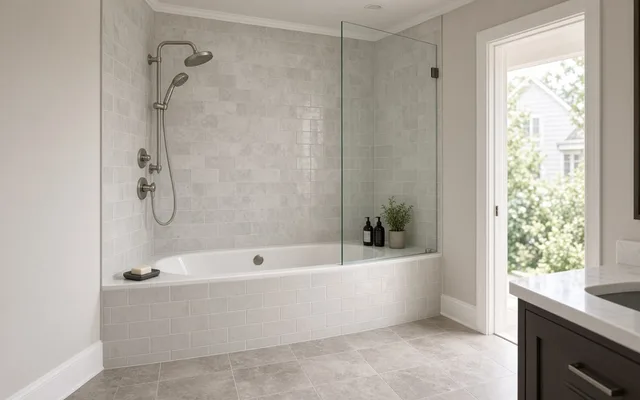
A tub-to-shower conversion removes the bathtub and builds a shower in its alcove, usually with a new drain, a rebuilt substrate, a waterproofing membrane, new walls and an enclosure.
 Service guideAccessible Bathroom Remodeling
Accessible bathroom remodeling plans the room around a specific person's transfers, reach, mobility aid and likely future needs: turning space, a curbless shower, blocking and grab bars, a comfort-height toilet, a reachable vanity, nonslip surfaces and a wider door.
Tell us the size, the condition of what is there now, and what you want to change. Bath Project Notes passes your request to independent local professionals, who reply with written, no-obligation estimates. The service is free to use.