Which accessibility feature matters most to your household?
Houzz found 68% of bathroom renovators considered current or future special needs.
No votes yet. Yours will be the first. · saved on this device
Loading...
Bath Project Notes · Accessible Bathroom Remodeling cost guide
An accessible bathroom remodel costs about $1,500 to $5,000 for basics added to an existing room, $10,000 to $18,000 to turn a tub into a curbless roll-in shower with a seat, and $20,000 to $35,000 or more for a full renovation that widens the door and moves the toilet in 2026. Structure, not fixtures, sets the tier, and some programs help pay for documented needs.
Accessibility costs are driven by how much of the room's structure moves. Grab bars, a comfort-height toilet and a handheld shower are inexpensive; recessing a shower floor, widening a door opening and relocating a toilet drain are not. Houzz found 68% of bathroom renovators considered current or future special needs and 47% planned for needs five or more years out, and AARP found 75% of adults over 50 want to stay in their current homes, so these costs are part of a growing share of bathroom budgets.
The cost table and calculator on this page carry the line items. This guide explains the three tiers, which lines are structural, how much is labor, how funding programs work, what to cut and what never to cut, and what three sample budgets look like. The dimensions and the design process are on the accessible remodeling page, and the shower entry decision has its own curbless versus curb comparison.
| Item | Low | High | Unit | Notes |
|---|---|---|---|---|
| Grab bars with blocking (three bars) | $600 | $1,500 | flat | Blocking requires open walls |
| Comfort-height toilet with bidet seat outlet | $600 | $1,500 | flat | Outlet requires electrical |
| Curbless roll-in shower with seat and linear drain | $10,000 | $18,000 | flat | From tub alcove, floor recessed |
| Door widening to 36 inches, outswing or pocket | $1,200 | $4,000 | flat | Framing and finish both sides |
| Wall-mounted vanity with knee space | $900 | $3,500 | flat | Includes lever faucet |
| Toilet relocation for transfer clearance | $1,500 | $4,000 | flat | Framed floor; slab higher |
| Nonslip porcelain floor tile | $12 | $30 | per sq ft | Wet DCOF 0.42 or higher |
| Accessibility assessment (OT or CAPS) | $150 | $600 | flat | May be covered by insurance or programs |
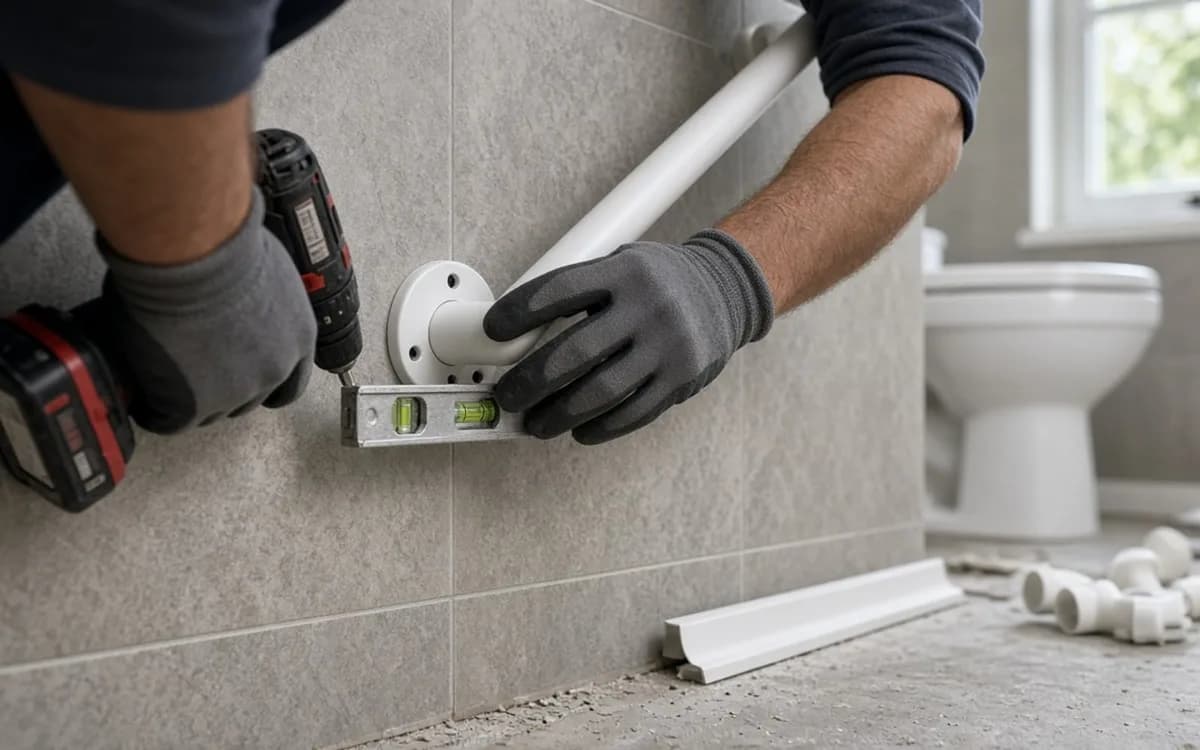
The basics tier changes fixtures and adds support without moving walls or drains: three grab bars on blocking where the walls can be opened locally, a comfort-height toilet, a handheld shower on a slide bar, lever handles, and nonslip tile or a treated floor. That runs $1,500 to $5,000. It suits prevention, a recent fall, or a person whose mobility is good but declining, and it can often be done in two to four days with the bathroom usable most nights.
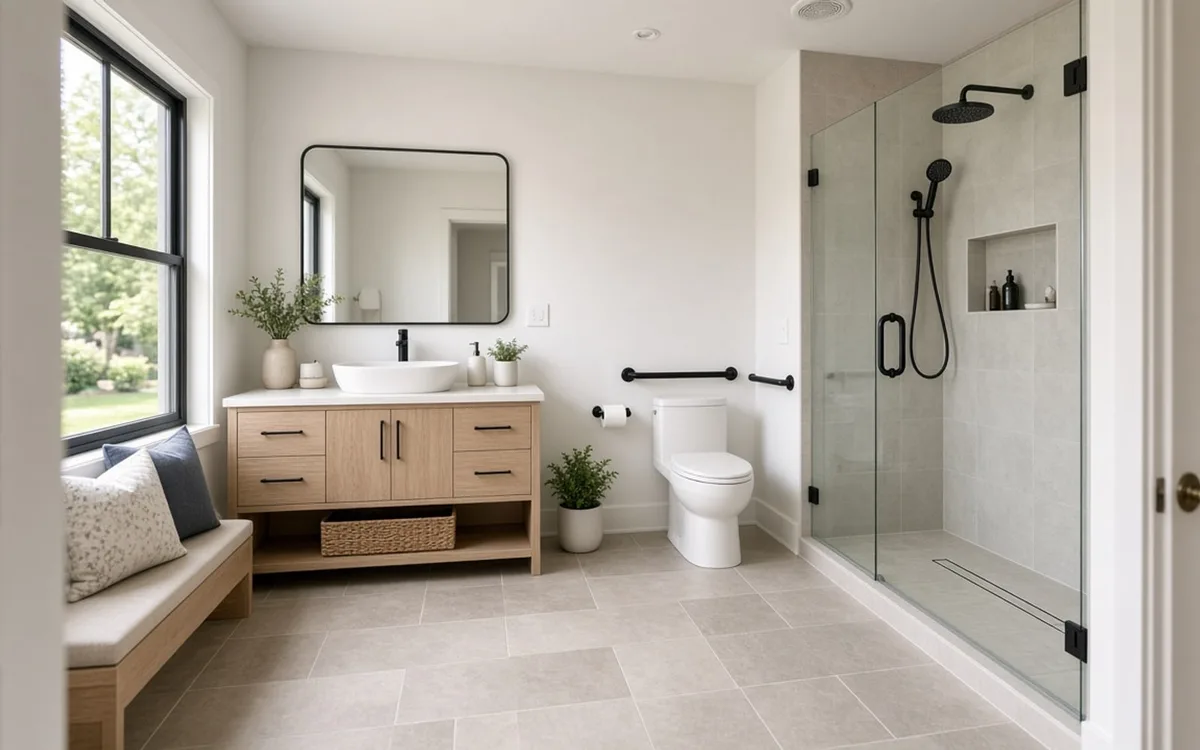
The shower tier replaces the tub or shower with a curbless roll-in or transfer shower, a fold-down seat, a thermostatic valve and a linear drain, for $10,000 to $18,000. The full tier adds structural changes elsewhere in the room: a door widened to 36 inches with an outswing or pocket door, a toilet moved for side-transfer clearance, a wall-mounted vanity with knee space, and turning space for a wheelchair. HomeGuide's $100 to $500 per-square-foot range for bathrooms explains why a large primary bath at this tier passes $35,000. Some go further to a wet room; Houzz found 26% of wet-room renovators chose that layout for accessibility.
Four lines account for most of the difference between tiers. Recessing the shower floor for a zero-threshold entry, on a framed floor, means cutting or dropping joists or building the rest of the floor up, typically $2,000 to $5,000 over a curbed shower. Widening a door costs $1,200 to $4,000 because it involves a new header, framing and finish on both sides. Moving a toilet for transfer clearance runs $1,500 to $4,000 on a framed floor and more on a slab. Continuous blocking on every wall is cheap but requires the walls open.
On a slab foundation, the recessed shower floor and the toilet move both involve saw-cutting and re-pouring concrete, which can add $3,000 to $6,000 to the shower and full tiers. That is why the assessment should come before the price: a person who transfers from a wheelchair onto a seat may do well with a 36-by-36 transfer shower and a very low curb, which avoids the recess entirely, while a person who uses a shower wheelchair needs the roll-in floor. The glossary defines both.
HomeAdvisor puts labor at 40% to 65% of a bathroom bill, with most contracting pros at $50 to $75 an hour and plumbers at $45 to $200, and accessible work sits at the upper end. Framing a recessed floor, reframing a door, blocking every wall and setting tile to a precise slope toward a linear drain are all labor-heavy, and a curbless floor demands a skilled setter who has done it before. The fixtures themselves, apart from a quality thermostatic valve and a rated fold-down seat, are not expensive compared with the hours needed to install them correctly.
The assessment is a small but distinct labor line: an occupational therapist or Certified Aging-in-Place Specialist visit costs $150 to $600, and some insurance plans or programs cover it. It is the cheapest line on the project and the one that prevents the costly errors, such as bars on the wrong side of the toilet for the person's transfer, a seat too deep to reach the controls from, or a door that still swings into the room after being widened.
Medicare generally does not pay for home modifications. Medicaid home and community-based waivers in many states do, within limits and for eligible people. The VA's HISA grant covers medically necessary bathroom changes for eligible veterans, and its larger SAH and SHA grants cover more extensive adaptation for qualifying service-connected disabilities. State aging agencies, local Area Agencies on Aging and some nonprofits run modification programs, and certain long-term-care policies reimburse specified work. Medical expense deductions may apply to part of the cost in some cases.
Almost every program requires documentation of need, often from a physician or occupational therapist, and many require approval before the contract is signed or the work starts. Build that into the schedule, and ask the pro whether they have worked with the program before, because some require itemized bids in a particular format. Harvard JCHS reports that homeowners 65 and over now account for 27% of improvement spending, and many of those projects include this kind of funded work.
Cut finishes before function. Standard porcelain with a good wet slip rating instead of large-format stone, a semi-frameless panel or a weighted curtain instead of frameless glass, a stock wall-mounted vanity instead of custom, and a basic bidet seat instead of a premium unit all save money without changing how the room works for its user. If the person does not use a wheelchair, a transfer shower with a very low curb can replace the roll-in shower and remove the floor recess from the budget. Accessible design also pays back less at sale: ImproveIt's summary of Cost vs. Value data shows a universal-design bath recouping 61.2% of its cost.
Never cut the assessment, the blocking, the linear drain in a curbless shower, the scald-limiting valve, the weight rating on the seat and bars, or the slip rating on the floor. The CDC counted 234,094 emergency-treated bathroom injuries in one year, with rates rising with age, and those items address the causes directly. Houzz found 23% of renovators added grab bars; with blocking in place, adding or moving one later is a short, inexpensive visit.
Basics for a hall bath, about $3,600: occupational therapist visit $250, three grab bars with local blocking $1,100, comfort-height toilet with bidet outlet $1,000, handheld on a slide bar with a diverter $450, lever faucet and handles $400, nonslip treatment of the existing floor $200, permit $200. Shower tier on a framed floor, about $14,500: tub removed, floor recessed, linear drain, bonded membrane with flood test, porcelain tile, fold-down seat, thermostatic valve, handheld, fixed glass panel, blocking and a fan.
Full accessible renovation of a 70-square-foot primary bath, $28,000 to $36,000: everything in the shower tier, plus a door widened to 36 inches with a pocket door, the toilet moved 8 inches for transfer space, a wall-mounted vanity with knee space, continuous blocking, even lighting with a sensor night light, and new slip-rated floor tile throughout. The calculator on this page returns comparable ranges when the premium tier and high complexity are selected.
The 2025 Cost vs. Value data credit a universal-design bathroom with recouping about 61.2% of its cost at sale, less than the roughly 80% for a midrange bath remodel. The gap reflects how appraisers value a specialized feature set, not the value to the household using it, and it narrows when the accessible features look like ordinary good design: a curbless shower with large tile, a wall-mounted vanity, a comfort-height toilet and bars that match the faucet finish.
For a household planning to stay, the comparison that matters is with the alternatives, such as a move or assisted living, which cost far more than a remodel in almost every case. Use the scope quiz if it is still unclear whether the basics or a full renovation is needed, and send the assessment with the brief through the request form so independent pros price the same plan.
By the numbers
Planning figures from published U.S. sources; every card links to where the number came from.
68%
of Houzz bathroom renovators considered special needs; 47% planned for needs 5+ years out
The 2025 Houzz Bathroom Trends Study found 68% of surveyed bathroom renovators considered current or future special needs, 47% anticipating needs five or more years away and 31% addressing current household needs. Platform sample of Houzz users who renovated.
Houzz / 2025 U.S. Houzz Bathroom Trends Study (2025)75%
of adults 50+ want to stay in their current home as they age (AARP 2024)
AARP's 2024 Home and Community Preferences Survey of more than 3,000 adults finds 75% want to remain in their current home, yet 44% believe a move is inevitable. The bathroom is the room that most often decides which of those happens.
AARP / 2024 Home and Community Preferences Survey (2024)40% to 65%
of a bathroom remodel bill is labor, per HomeAdvisor
Because plumbing, tile and electrical work are labor-intensive, HomeAdvisor estimates labor takes 40% to 65% of the total. That is why small bathrooms cost more per square foot and why a tile-heavy shower dominates a proposal.
HomeAdvisor / Bathroom Remodel Cost Guide (2025)27%
of improvement spending comes from homeowners 65+, double their share 20 years ago
Harvard JCHS's Improving America's Housing 2025 finds owners 65 and over accounted for 27% of improvement outlays in 2023 versus 14% two decades earlier, a key driver of accessible bathroom demand.
Harvard JCHS / Improving America's Housing 2025 (2025)The calculator uses the same bathroom remodeling benchmarks as this guide. Set the size and tier, then request a written estimate to check it against a real proposal.
Homeowner polls
Houzz found 68% of bathroom renovators considered current or future special needs.
No votes yet. Yours will be the first. · saved on this device
No votes yet. Yours will be the first. · saved on this device
Low-curb showers led Houzz's 2025 data at 44%; curbless were 20%.
No votes yet. Yours will be the first. · saved on this device
No. A person who walks with a cane or transfers from a wheelchair onto a seat can often use a transfer shower with a curb of an inch or less, which avoids the $2,000 to $5,000 floor recess. A person who bathes in a shower wheelchair, or who shuffles and cannot lift a foot reliably, needs zero threshold. The assessment should decide this, not the budget alone.
About $200 to $800 for the seat, depending on material and weight rating, plus blocking behind the wall if it is not already there. Teak and phenolic seats rated to 300 pounds or more are common. The installation line matters more than the seat: it needs solid backing and a height and depth that lets the user reach the controls and the handheld while seated.
Offset hinges on an existing door gain about two inches of clear opening for under $100 and are the first thing to try. Widening the rough opening to take a 36-inch door, with a new header and trim on both sides, runs $1,200 to $4,000. A pocket door adds cost for the frame but frees floor space that a swinging door would take.
It depends on the program. Some pay the contractor on completion against an approved itemized bid, some reimburse the homeowner, and some cap the amount below the project's cost so the household pays the difference. Most require pre-approval and documentation of need. Ask the program for its process in writing before signing a contract, and confirm the pro will produce the bid format it requires.
Some can. Blocking, the drain position and the shower floor are structural, so do them together even if the bars and seat come later. A comfort-height toilet, lever handles and a handheld shower can be added at any time without opening walls. The mistake is phasing the structural work, which means demolishing finished tile twice.
Not much. A linear drain needs its grate lifted and cleaned every few months, a fold-down seat's hinges benefit from an occasional check, and a bidet seat has a filter and nozzle to clean. A curbless floor with a correct slope keeps water where it belongs; one with a poor slope becomes a maintenance problem, which is why the installer's experience is a cost question.
It should include a dimensioned plan with turning space and transfer clearances, the blocking layout, the shower floor method, the drain type, the valve with its scald limit, the seat and bar weight ratings, the floor tile's slip rating, the door work, and the fan. A bid that lists fixtures and a total without a plan cannot be compared with one that has a plan.
 Complete Bathroom Renovation · Cost guideComplete bathroom renovation cost in 2026: tiers, add-ons and what to cut first
A complete bathroom renovation in 2026 typically costs $9,000 to $16,000 with a prefab shower, $14,000 to $28,000 with a tiled shower and glass, and $22,000 to $50,000 or more when a drain or wall moves.
 Walk-In Shower Installation · Cost guideWalk-in shower installation cost in 2026: what each layer of the assembly adds
A walk-in shower installed in an existing footprint costs about $3,500 to $7,000 with a prefab base and acrylic surround, $7,000 to $13,000 tiled on a tile-ready base with semi-frameless glass, and $11,000 to $18,000 curbless with a linear drain and frameless glass in 2026.
 Tub & Shower Conversions · Cost guideTub-to-shower conversion cost in 2026: from tub removal to finished glass
A tub-to-shower conversion costs about $4,000 to $7,000 with a prefab base and surround, $7,000 to $11,000 with a tile-ready base, tiled walls and semi-frameless glass, and $11,000 to $15,000 or more for a curbless tiled shower in 2026.
 Service guideAccessible Bathroom Remodeling
Accessible bathroom remodeling plans the room around a specific person's transfers, reach, mobility aid and likely future needs: turning space, a curbless shower, blocking and grab bars, a comfort-height toilet, a reachable vanity, nonslip surfaces and a wider door.
Service guideTub & Shower ConversionsA tub-to-shower conversion removes the bathtub and builds a shower in its alcove, usually with a new drain, a rebuilt substrate, a waterproofing membrane, new walls and an enclosure.
Service guideWalk-In Shower InstallationA walk-in shower installation rebuilds the bathing area from the subfloor up: a sloped base, a drain bonded to a waterproofing membrane, wall board and membrane, a valve, tile or panels, and an enclosure with a defined entry.
 Free toolBathroom remodel cost calculator
Size, material tier and complexity in, a realistic budget range out.
 Free toolBathroom comparisons: the five decisions that change the assembly
Side-by-side tables for the decisions that change the price most.
 Free toolBathroom remodel quiz: find your scope and check the numbers
10 questions that show what you already know and what to check next.
 Free toolBathroom remodel polls: see what other homeowners are choosing
See what other planners chose and add your vote.
Tell us the size, the condition of what is there now, and what you want to change. Bath Project Notes passes your request to independent local professionals, who reply with written, no-obligation estimates. The service is free to use.