What total budget are you planning for?
Angi's typical range is $6,648 to $17,646; Houzz's major-remodel median is $22,000.
No votes yet. Yours will be the first. · saved on this device
Loading...
Bath Project Notes · Costs
In 2026 a bathroom remodel typically runs from about $5,000 for a fixture refresh to $50,000 or more for a layout change with a curbless tiled shower, with published national averages between $12,000 and $16,000. Labor takes roughly half the bill. The scope, whether a drain moves, the shower assembly, glass, and your region drive the price far more than tile does. This guide breaks each driver down with its source.
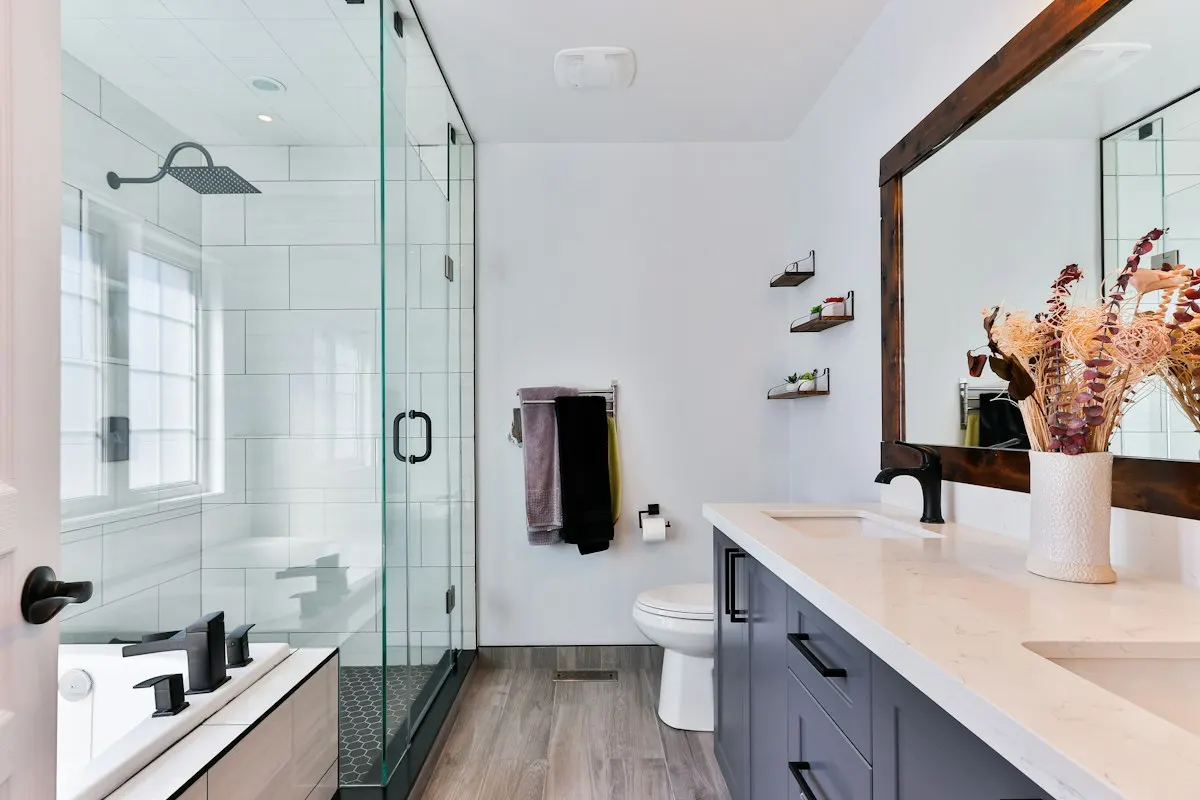
Photo: Lotus Design N Print · License.
By Bath Project Notes editorial · Updated 2026-09-25
Published bathroom cost figures disagree because they measure different things. HomeAdvisor reports an average of $12,151 with a typical range of $6,651 to $17,657; This Old House puts the 2026 average at $15,586 with a range of $6,456 to $24,715; Angi's planning benchmark is $6,648 to $17,646. Houzz, surveying its own users, reports a $13,000 median across all 2024 bathroom remodels and $22,000 for major ones. Its 2026 study puts 2025 medians at $15,000 for a primary bath, $7,000 for a guest bath and $30,000 for a major remodel of a primary bath over 100 square feet.
None of these is your quote. This guide uses them as anchors, then prices the room by scope, size and line item, splits labor from materials, and shows which costs hide until demolition. The calculator applies the same anchors to your square footage and finish tier.
The scope is the first and largest cost decision. A fixture and finish refresh, replacing vanity, toilet, faucet, lighting, floor and paint with the shower untouched, typically runs $5,000 to $12,000. A walk-in shower rebuilt in the existing footprint runs $3,500 to $7,000 prefab and $7,000 to $13,000 tiled, and $11,000 to $18,000 curbless. HomeAdvisor's tub-to-shower conversion range is $1,500 to $8,000.
A same-layout complete renovation runs $9,000 to $16,000 with a prefab shower and $14,000 to $28,000 with a tiled shower and glass; add a drain or wall relocation and the range is $22,000 to $50,000 or more. An accessible remodel with a roll-in shower, wider door and relocated toilet lands in the upper half of that range. Each service page has a fuller cost table for its scope.
| Scope | 2026 planning range | What is opened |
|---|---|---|
| Fixture and finish refresh | $5,000 – $12,000 | Nothing structural; shower stays closed |
| Walk-in shower, prefab base | $3,500 – $7,000 | Wet walls and shower floor |
| Walk-in shower, tiled with glass | $7,000 – $13,000 | Wet walls and shower floor |
| Tub-to-shower conversion | $4,000 – $15,000 | Alcove walls, floor at the drain |
| Same-layout full renovation | $9,000 – $28,000 | All walls, floor, fixtures |
| Renovation with drain or wall moves | $22,000 – $50,000+ | Everything, plus structure or slab |
Size moves the total less than scope does, because the shower, toilet, fan and permit cost about the same in any room. This Old House's 2026 pricing adds roughly $3,200 at the low end of each step from a small bath to a primary one. HomeAdvisor's ranges by bathroom type run far wider because each spans a cosmetic update and a gut renovation. The table in this section lists both with their source; use the size rows to check a quote and the scope table to plan one.
| Bathroom | Published range | Source |
|---|---|---|
| Small, 40–60 sq ft | $12,695 – $14,845 | This Old House, 2026 |
| Medium, 70–90 sq ft | $15,920 – $18,070 | This Old House, 2026 |
| Large, 100–120 sq ft | $19,166 – $21,295 | This Old House, 2026 |
| Primary, 130+ sq ft | $22,370 – $24,715 | This Old House, 2026 |
| Half bath or powder room | $1,500 – $15,000 | HomeAdvisor |
| Full bath | $3,500 – $20,000 | HomeAdvisor |
| Primary bath | $7,000 – $30,000 | HomeAdvisor |
Line-item figures are for checking a proposal one row at a time. HomeAdvisor's ranges include installation and span budget to luxury products, so read them as brackets; This Old House reports 2026 averages. The widest rows, plumbing and the shower, are wide because of the drain: a fixture set on an existing line costs a fraction of one that moves. Permit fees are listed on their own because many proposals leave them out.
| Item | Published cost | Source |
|---|---|---|
| Toilet, installed | $350 – $4,000 | HomeAdvisor |
| Sink, installed | $60 – $5,000 | HomeAdvisor |
| Bathtub, installed | $300 – $11,000 | HomeAdvisor |
| Shower, installed | $200 – $15,000 | HomeAdvisor |
| Demolition | $1,000 – $2,300 | HomeAdvisor |
| Permits | $100 – $1,000 | HomeAdvisor |
| Shower installation | $8,044 average | This Old House, 2026 |
| Plumbing | $5,545 average | This Old House, 2026 |
| Cabinetry | $2,929 average | This Old House, 2026 |
| Tiling | $1,326 average | This Old House, 2026 |
| Flooring | $1,114 average | This Old House, 2026 |
Moving a drain is the largest single upward driver: $1,500 to $4,000 on a framed floor and $3,000 to $6,000 on a slab, before the tile that has to be redone around it. Next is the shower assembly itself. A tiled floor with a bonded membrane costs $1,200 to $5,000 against $400 to $1,500 for a prefab base; a curbless entry adds $2,000 to $5,000 for the floor recess and extended membrane; frameless glass adds $1,500 to $4,000.
The pulls downward are the same items chosen the other way. Keeping every drain in place nearly removes the rough plumbing line. A prefab base with solid-surface panels, covered in the tile versus panels comparison, cuts wall labor by days. A stock vanity with a quartz top, which Houzz reports 45% of renovators chose, gives most of the custom look. Cutting the fan or the membrane is the saving that costs more later.
HomeAdvisor estimates labor at 40% to 65% of a bathroom remodel bill, with most contracting pros at $50 to $75 an hour and plumbers at $45 to $200 an hour; the higher end of the share applies to tiled showers and layout changes. A bathroom is dense with trades: demolition, plumbing rough and trim, electrical rough and trim, framing or blocking, backer board and waterproofing, tile setting and grouting, glass, painting and finish carpentry, often with a separate fan and duct installer. Each trade mobilises for a small room, and each visit carries setup time a larger room would spread out.
Materials split into the assembly and the finishes. Membrane, backer board, drain, valve, base or pan, blocking and fan are the assembly, usually $1,500 to $4,000 in a shower rebuild, and they should never be the place a bid saves money. Finishes are tile, glass, vanity, top, toilet, faucet, lighting and accessories, and they range from a few thousand dollars to more than the labor. A proposal that separates labor, assembly materials and finish allowances lets you see whether a low bid is low on labor, which is worrying, or low on finishes, which is a choice.
Labor rates are the main regional variable. Coastal metros in the Northeast and West commonly run fifteen to thirty-five percent above national figures for skilled trades, and licensed plumbers and electricians in those markets book weeks out. Permit fees and inspection counts also vary: some cities require separate plumbing, electrical and building permits with a fee for each, while others issue one remodel permit. Material prices vary less, though tile and glass delivery charges rise outside metro areas.
Housing stock sets a second layer. The EIA's 2024 survey finds 56.1% of Northeast homes have exactly one full bathroom, which raises the cost of keeping a household functional and often means older plumbing. In the South, where 53.0% of homes have two full bathrooms and slabs dominate, a drain move means saw-cutting concrete.
The predictable surprises are water damage under a tub or behind a shower, a subfloor that needs replacing at $15 to $35 per square foot, rotted framing at the curb or the window, and a toilet flange set below the new floor height. The less obvious ones are code corrections: a fan ducted into the attic, no GFCI protection, an undersized drain that cannot serve a new shower, and galvanized supply lines that should be replaced while the wall is open.
Then there are costs outside the contract: permit fees, an assessment, a dumpster, temporary shower arrangements, extra tile for waste and repairs, and accessories nobody prices. Houzz reports 37% of renovators went over budget in 2025 and that credit card use rose to 34%; a written contingency of ten to twenty percent is what keeps the overrun from becoming debt.
Start with what is named: the shower base, the membrane system, the drain, the entry, the enclosure, the fan's CFM and duct route, the allowances with amounts, whether permits are included, and what happens, at what price, when existing conditions differ. Anything not named is not priced; the glossary explains each term.
Then compare structure, not totals. Put three proposals side by side by line: demolition, rough plumbing, rough electrical, assembly materials, tile labor, tile allowance, glass, vanity and top, fixtures, fan, paint and trim, permits. A low tile labor number with a tiled floor usually means a thinner assembly; a low plumbing number with a drain move usually means the slab cut is not included. The estimate request page describes how to ask for this format from the start.
Resale figures set expectations, not budgets. The 2025 Cost vs. Value Report shows a midrange bathroom remodel recouping about 80% of its cost, an upscale one far less. NAR's 2025 Remodeling Impact Report, built on Realtor estimates, puts bathroom cost recovery at 50%. Both say a moderate, well-built bathroom returns more of its cost than a lavish one.
Operating costs are a small offset. Bathrooms use 50%+ of a home's indoor water, per the EPA; a WaterSense toilet replacing an old 6-gallon model saves about 13,000 gal a year and a WaterSense showerhead 2,700 gal. Worth choosing, not worth stretching the budget for.
A $9,000 hall-bath refresh with shower: prefab base and acrylic surround $2,200, semi-frameless door $900, stock vanity and top $1,100, toilet and faucet $700, floor tile and labor $1,400, fan and duct $600, paint, trim and accessories $600, demolition and disposal $700, permit $300, contingency $500. Labor sits near half of the total. This is the economy tier in the calculator at about 40 square feet, about $2,000 above Houzz's $7,000 guest-bath median, which also counts jobs that leave the shower alone.
A $22,000 same-layout primary bath: tiled shower on a bonded membrane with flood test $6,500, frameless glass $2,500, semi-custom vanity with quartz top $3,200, comfort-height toilet and thermostatic valve $1,400, porcelain floor and wall tile with labor $3,800, ducted humidity-sensing fan $700, lighting and electrical $900, paint, trim and accessories $900, demolition and permit $1,100, contingency $1,000. This matches Houzz's $22,000 major-remodel median. A $40,000 version adds a drain move, curbless entry, heated floor, double vanity and a wider door, which is where an accessible remodel usually lands.
Mostly from savings. This Old House's survey of 1,000 homeowners found 49% paid for a bathroom remodel from cash or savings and 29% put part of it on credit cards. Houzz's 2026 study, covering all renovations, found 84% drew on savings and 34% used credit cards, up five points in a year. Card interest on a balance carried for years adds real money; a home equity line or personal loan usually costs less. Whatever the source, borrow for the contract plus the contingency, so a discovered repair does not force a second loan mid-project.
On labor, the same This Old House survey found 40% hired a licensed contractor, 30% did most or all of the work themselves and 23% split it. Demolition of finishes, paint and accessories are reasonable owner tasks. Plumbing, wiring, the membrane and the flood test are where DIY savings turn into repair bills, and many jurisdictions require a licensed trade to pull those permits, as the permits guide explains.
Homeowner polls
Angi's typical range is $6,648 to $17,646; Houzz's major-remodel median is $22,000.
No votes yet. Yours will be the first. · saved on this device
No votes yet. Yours will be the first. · saved on this device
Houzz found 75% of bathroom renovators upgraded the shower and 27% the tub.
No votes yet. Yours will be the first. · saved on this device
They measure different populations. HomeAdvisor's figure comes from projects reported to its platform, spanning small updates to full renovations, while Houzz surveys its own users, who skew toward larger, design-led projects, and reports a median rather than an average. This Old House and Angi compile from multiple sources. Use the spread as the planning range and your scope to decide where in it your project sits.
In a full renovation with a tiled shower, the shower assembly, tile and glass typically take thirty-five to fifty percent of the total. That share is appropriate because the shower is the part that fails first and costs the most to redo. If a proposal spends far less than that on the shower relative to the vanity and finishes, ask what assembly it assumes; the saving is often in the membrane or the base.
Yes, generally. The fixed costs, such as the shower assembly, the toilet, the fan, permits and mobilisation, do not scale with floor area, so a 100-square-foot bathroom costs more in total but less per square foot than a 40-square-foot one. Houzz's 2026 study puts a major remodel of a primary bath at a $30,000 median over 100 square feet against $18,000 under it, so the larger room costs about two-thirds more, not twice as much.
It sets a reserve, often ten to twenty percent of the contract, spent only on conditions discovered and photographed, and lists unit prices for the likely repairs: subfloor per square foot, framing per linear foot, supply lines per run. Unspent reserve is not billed. Without unit prices, damage is priced under pressure with the room open.
Sometimes, and it removes the contractor's markup, typically ten to twenty-five percent. In exchange the contractor will not warranty those products, late deliveries are your schedule risk, and mismatched rough-in parts, such as a valve body from a different line than the trim, are common. Buy complete kits from one manufacturer and have the contractor confirm each item first.
An electric radiant mat with a thermostat and a dedicated circuit typically adds $800 to $2,000 installed in a standard bathroom, and NKBA reports 57% of designers say clients want it. Plan it at rough-in, when the circuit and thermostat box go in with the other wiring; it cannot be added after tile without removing the floor.
If the shower is sound, properly anchored grab bars, a handheld on a slide bar, a nonslip treatment, a comfort-height toilet and better lighting cost a few thousand dollars together and address most fall risks. Houzz reports 23% of renovators added grab bars and 24% added nonslip shower flooring. A curbless entry, the largest safety improvement, requires opening the floor and belongs in a shower rebuild.
 Service guideComplete Bathroom Renovation
A complete bathroom renovation rebuilds the bathing area, vanity, toilet, floor, wall finishes, lighting and ventilation together, and may move drains, walls or the door.
 Service guideWalk-In Shower Installation
A walk-in shower installation rebuilds the bathing area from the subfloor up: a sloped base, a drain bonded to a waterproofing membrane, wall board and membrane, a valve, tile or panels, and an enclosure with a defined entry.
 Service guideTub & Shower Conversions
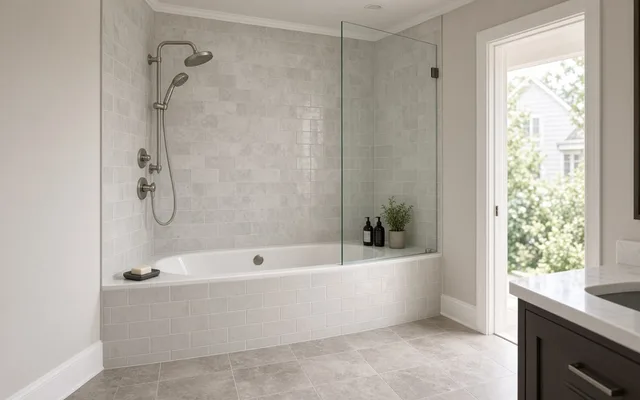
A tub-to-shower conversion removes the bathtub and builds a shower in its alcove, usually with a new drain, a rebuilt substrate, a waterproofing membrane, new walls and an enclosure.
 Service guideAccessible Bathroom Remodeling
Accessible bathroom remodeling plans the room around a specific person's transfers, reach, mobility aid and likely future needs: turning space, a curbless shower, blocking and grab bars, a comfort-height toilet, a reachable vanity, nonslip surfaces and a wider door.
 PlanningHow to plan a bathroom remodel, from the first question to the first day of demolition
Planning a bathroom remodel means deciding what to open before deciding what to buy.
 MaterialsBathroom materials and options, organised by the assembly they belong to
Bathroom materials are best chosen by assembly, not by showroom.
 PermitsPermits and codes for a bathroom remodel: what applies, who checks it, and what it costs to skip
Yes, in most U.S.
 Free toolBathroom remodel cost calculator
Size, material tier and complexity in, a realistic budget range out.
 Free toolBathroom comparisons: the five decisions that change the assembly
Side-by-side tables for the decisions that change the price most.
 Free toolBathroom remodel quiz: find your scope and check the numbers
10 questions that show what you already know and what to check next.
 Free toolBathroom remodel polls: see what other homeowners are choosing
See what other planners chose and add your vote.
Tell us the size, the condition of what is there now, and what you want to change. Bath Project Notes passes your request to independent local professionals, who reply with written, no-obligation estimates. The service is free to use.