What will the shower walls be?
89% of NKBA designers prefer smaller or no grout lines.
No votes yet. Yours will be the first. · saved on this device
Loading...
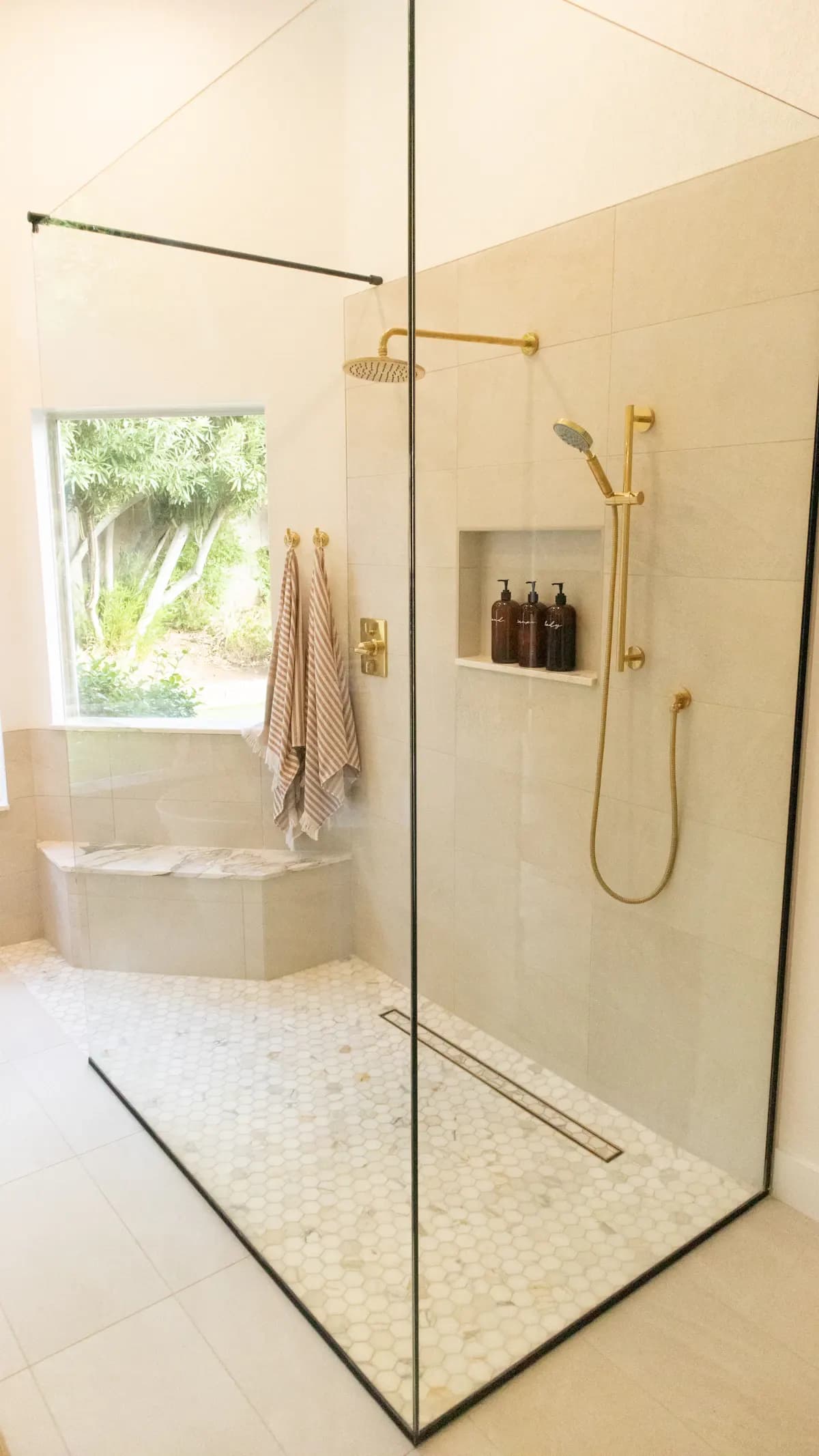
Bath Project Notes · Tiled shower walls vs Solid-surface or acrylic wall panels
Choose tile when the shower is a design feature, the size is custom or the house is in the mid-to-upper market, and accept grout maintenance and two to five days of wall labor. Choose solid-surface or acrylic panels when cleaning time, speed and a hall-bath budget matter more than pattern choice; they install in a day with three sealed joints. Both need a waterproofing membrane behind them, whatever the sales pitch says.
Photo: Alexander Fife · License.
Shower walls are the most visible surface in the bathroom and the one with the widest cost and labor range. Tile means any look, any niche and any size, set piece by piece over several days with grout that needs care. Panels mean a few large sheets, a day's installation and almost no maintenance, in a narrower range of looks. The comparison table gives the headline rows; the sections below add the scenarios, the ten-year cost, the humid-climate case, the resale reading and what to check in a proposal.
The market has moved toward less grout. NKBA's 2026 report finds 89% of designers want smaller or no grout lines, and Houzz's 2025 feature findings show 75% of bathroom renovators upgraded the shower and 81% upgraded wall finishes, so this choice is being made in most projects. The materials guide places walls in the wider assembly; this page is only about the walls.
Tile offers any design and any size at higher labor and with grout to maintain; panels have a few sealed joints, install in a day and clean easily, at the cost of design range. Both need a membrane behind them.
| Factor | Tiled shower walls | Solid-surface or acrylic wall panels |
|---|---|---|
| Upfront cost | $1,500 – $6,000 for walls, labor-heavy | $900 – $4,000; solid surface at the top |
| Lifespan | 20–30 yrs on a good membrane | Acrylic 10–20 yrs; solid surface 20+ |
| Maintenance | Grout sealing and scrubbing | Wipe down; three joints to caulk |
| Appearance | Unlimited; niches, patterns, large format | Limited patterns; seamless look |
| Climate fit | Humid regions: more grout to keep clean | Better in humid rooms with weak ventilation |
| Install time | 2–5 days plus grout cure | Half a day to a day |
| Resale / ROI | Expected in mid-to-upper homes | Accepted in hall baths; acrylic reads as budget |
| Best for | Primary baths, custom sizes, design-first | Hall baths, rentals, low-maintenance households, fast schedules |
Tile wins in the primary bath, in any custom-size shower, and for households that care about design. NKBA found 89% of designers want smaller or no grout lines and 80% expect large-format tile to dominate, which narrows the maintenance gap. It loses in a room with weak ventilation where grout will stain no matter what.
Panels win in hall baths, on tight schedules, and for households that will not maintain grout. Solid-surface panels in a stone look are a legitimate primary-bath finish; acrylic surrounds are a hall-bath finish. Either way, the membrane behind the panels is what keeps the wall dry; a panel glued to drywall is the conversion that fails. See the walk-in shower page for the wall assembly.
Tile suits a primary bath where the shower is the room's feature, a custom-size shower that no panel kit fits, a design that wants a niche, a bench and a pattern, and a household that will seal grout every year or two or pay for epoxy grout to avoid it. Tile also suits any shower where the floor is tiled and the walls should match, and a curbless design where large-format porcelain runs from the room floor up the walls without interruption. Houzz found 24% of bathroom renovators use the room for pampering, the households most likely to value that.
Panels suit a hall bath or a rental, a household that wants a wipe-down shower with no scrubbing, a schedule that needs the shower back in days, and a budget where the difference between $900 and $4,000 for panels and $1,500 to $6,000 for tile decides something else on the list. Solid-surface panels in stone-look finishes have closed much of the appearance gap; acrylic still reads as budget. Panels also suit a tub surround where the tub stays, which the tub versus shower comparison addresses.
Upfront, tiled walls in a standard shower run $1,500 to $6,000 including labor, with large-format porcelain and complex patterns at the top; panels run $900 to $4,000, with acrylic at the bottom and solid surface at the top. Tile takes two to five days plus grout cure before use; panels take half a day to a day. In a tub-to-shower conversion, panels can bring the shower back into service two to four days sooner, which matters in a one-bathroom house, which our analysis of the EIA's 2024 household survey puts at 38.6% of occupied U.S. homes.
Over ten years, tile adds sealing every one to two years for cement grout, occasional grout repair, and eventually regrouting, a few hundred dollars each time if hired out; epoxy grout removes most of that for a few hundred dollars more at installation. Panels add recaulking of the joints every three to five years, a small cost. Lifespans differ: tile on a good membrane lasts twenty to thirty years; solid surface twenty or more; acrylic ten to twenty, after which it can yellow or craze. On a twenty-year view, tile and solid surface are close and acrylic is replaced once.
| Item | Tile | Solid surface | Acrylic |
|---|---|---|---|
| Walls installed | $1,500 – $6,000 | $2,500 – $4,000 | $900 – $2,000 |
| Install time | 2 – 5 days plus cure | Half to one day | Half day |
| Ten-year upkeep | Sealing, grout repair | Recaulk joints | Recaulk; possible replacement |
| Expected life | 20 – 30 years | 20+ years | 10 – 20 years |
In humid regions and in any bathroom with weak ventilation, grout is where mold shows first. Panels' three sealed joints give it fewer places to start, and a wipe-down surface dries faster. That is the strongest practical case for panels, and it is stronger still in a shower with no window and a fan that is undersized. The fix is the fan, not the wall material, but if the fan cannot be improved, panels are the more forgiving wall.
In dry regions the difference shrinks; grout dries between showers and sealed tile behaves well. Hard water is the other regional variable: mineral deposits build on both surfaces, but they are easier to remove from a smooth panel than from grout lines, and etching from aggressive descaling products damages some solid-surface finishes. Whichever wall goes in, the walk-in shower page describes the fan sizing and duct route that keeps either one clean.
Tile is expected in the primary bath of a mid-to-upper-market house, and its absence is noticed. Panels are accepted in hall baths, secondary baths and rentals, and good solid-surface panels are increasingly accepted in primary baths as buyers recognise the low-maintenance case; acrylic surrounds read as budget in most markets. The 2025 Cost vs. Value midrange bathroom, which recoups about 80%, assumes a ceramic tile surround, which is a fair indication of what appraisers consider standard.
The resale effect is small relative to the other decisions on this site. A well-built panel shower in a clean, well-lit, well-ventilated hall bath does more for a sale than a tiled shower with cracked grout in the same room. If the house will sell within a few years and the shower is in the primary bath, tile is the safer call; if the household is staying and hates cleaning, panels are the better use of the money. NKBA's 2026 report found 89% of designers want smaller or no grout lines, and panels deliver that for less.
With tile, the mistakes are a proposal that names the tile but not the membrane, a tile allowance too low for the described look, a layout that puts a cut tile row at eye level, a niche placed on an exterior wall without insulation behind it, and cement grout in a household that will never seal it. With panels, the mistakes are panels glued directly to old drywall or old tile with no moisture-resistant backer, joints sealed with the wrong sealant, a kit that does not fit the alcove and gets trimmed unevenly, and a base from a different manufacturer with an unsupported transition.
The shared mistake is treating the wall material as the waterproofing. The glossary entry for waterproofing membrane makes the point: tile and grout are not waterproof, and neither are panel joints. Any proposal for either option should name the membrane or moisture barrier behind the wall, the backer it goes on, and how it ties into the base. A proposal that says only tile or only panels is incomplete.
They will not have the same line items, so compare the assembly first. Both should show demolition, backer, membrane or moisture barrier, base, valve, and glass; the wall line is where they diverge. Ask the tile bid for the tile allowance, the labor for setting and grouting, the grout type and the number of days. Ask the panel bid for the panel material and brand, the joint count, the sealant, the backer, and whether the base is from the same system.
Then compare the whole-project timeline and the maintenance you will actually do. If the tile bid is $3,000 higher and the household is one that seals grout, that is the price of design range. If the tile bid is $3,000 higher and the household will never seal it, the panel bid is buying a shower that will look better in year eight. The calculator treats a tiled shower as its standard tier; the shower walls poll shows how other planners are leaning.
Homeowner polls
89% of NKBA designers prefer smaller or no grout lines.
No votes yet. Yours will be the first. · saved on this device
No votes yet. Yours will be the first. · saved on this device
No votes yet. Yours will be the first. · saved on this device
Yes. Slabs of 48 by 96 inches or larger give a tile look with two or three joints per wall, at a premium for material and for the crew that can handle them. They are the option NKBA's designers describe when they say minimal grout, and they suit primary baths with a design budget.
Some franchise installers do it. It hides whatever is behind the old tile, adds thickness that affects the valve trim and door, and cannot be inspected. If the old tile is on a sound membrane it can work; if not, you have covered a problem. Removing the old wall to the studs is the version this site describes.
Porcelain and glazed ceramic tile do not; cement grout does, every one to two years, unless an epoxy or high-performance grout is used, which costs more up front and never needs sealing. Natural stone tile needs sealing on schedule. Ask the proposal to name the grout type.
Not like tile, but increasingly like stone. Current solid-surface panels come in marble, slate and concrete looks with realistic veining, and because they have no grout lines they read as slab rather than tile. Acrylic panels have a glossy, molded look and sometimes molded-in shelves and faux tile lines, which most people recognise as a surround. If the goal is a tile pattern with grout lines, only tile does that.
For tiled walls, count on two to five days of setting and grouting plus one to three days before the shower is used, depending on grout type; with a tiled floor and flood test the whole shower is typically out for one to two weeks from demolition. For panels, the walls go up in a day, and with a prefab base the shower can be back in service in three to five days from demolition, glass permitting.
Yes, and it is common: a tiled feature wall behind the showerhead with panels on the two side walls, or tile on the walls and a solid-surface base. The transitions need to be planned so the membrane is continuous and the sealant joints are accessible. Mixed systems work best when one contractor is responsible for the whole assembly and names how each junction is handled.
Some solid-surface systems offer matching niches and shelves that are bonded into the panel; acrylic surrounds often have molded shelves. A tiled niche cut into a panel wall is possible but creates a lot of joints to seal. If a recessed niche is important, tile is the simpler route; if a shelf is enough, a surface-mounted solid-surface shelf or a corner shelf on a panel wall does the job.
Often, yes. A tub surround in acrylic or solid surface replaces a tiled tub surround with failing grout in a day, and the tub rim joint is the only tricky seal. The old tile must be removed and the wall inspected and rebuilt with a proper backer; panels glued over old tile trap moisture and hide damage. If the tub itself is worn, replace it at the same time so the rim seal is made once.
Tile: a single cracked tile can be cut out and replaced if spare tiles were kept, which is why ordering ten percent extra matters. Solid surface: scratches can be sanded out, but a cracked panel is replaced whole. Acrylic: small cracks can be patched with a repair kit; large damage means replacing the panel or the surround. Keep the manufacturer and color name for whichever wall is chosen.
 ComparisonKeep or replace the bathtub vs Convert to a walk-in shower
Convert the tub to a walk-in shower when nobody in the household bathes, stepping over the rim is becoming difficult, or the alcove is the only place a usable shower can go, and keep it when it is the only tub in the house, young children use it, or resale is near.
 ComparisonCurbless (zero-threshold) shower vs Low-curb or standard-curb shower
A curbless shower is the safest entry and the one that still works if a walker or wheelchair arrives, but it needs the floor recessed or raised to keep the slope and a membrane extended into the room, adding $2,000 to $5,000.
 ComparisonPrefabricated shower base vs Tiled shower floor
A prefabricated acrylic or solid-surface base installs in half a day, has no floor grout, uses a standard drain and costs $400 to $1,500 plus setting; it fits standard alcoves and fast schedules.
 ComparisonFixture and finish refresh vs Full renovation
Refresh when the shower assembly is sound and under ten years old, the fan ducts outdoors, and the complaint is dated finishes; a refresh of vanity, toilet, faucet, lighting, floor and paint runs $5,000 to $12,000 and takes about a week.
 Service guideComplete Bathroom Renovation
A complete bathroom renovation rebuilds the bathing area, vanity, toilet, floor, wall finishes, lighting and ventilation together, and may move drains, walls or the door.
 Service guideWalk-In Shower Installation
A walk-in shower installation rebuilds the bathing area from the subfloor up: a sloped base, a drain bonded to a waterproofing membrane, wall board and membrane, a valve, tile or panels, and an enclosure with a defined entry.
 Service guideTub & Shower Conversions
A tub-to-shower conversion removes the bathtub and builds a shower in its alcove, usually with a new drain, a rebuilt substrate, a waterproofing membrane, new walls and an enclosure.
 Service guideAccessible Bathroom Remodeling
Accessible bathroom remodeling plans the room around a specific person's transfers, reach, mobility aid and likely future needs: turning space, a curbless shower, blocking and grab bars, a comfort-height toilet, a reachable vanity, nonslip surfaces and a wider door.
 Free toolBathroom remodel cost calculator
Size, material tier and complexity in, a realistic budget range out.
 Free toolBathroom remodel quiz: find your scope and check the numbers
10 questions that show what you already know and what to check next.
 Free toolBathroom remodel polls: see what other homeowners are choosing
See what other planners chose and add your vote.
Tell us the size, the condition of what is there now, and what you want to change. Bath Project Notes passes your request to independent local professionals, who reply with written, no-obligation estimates. The service is free to use.